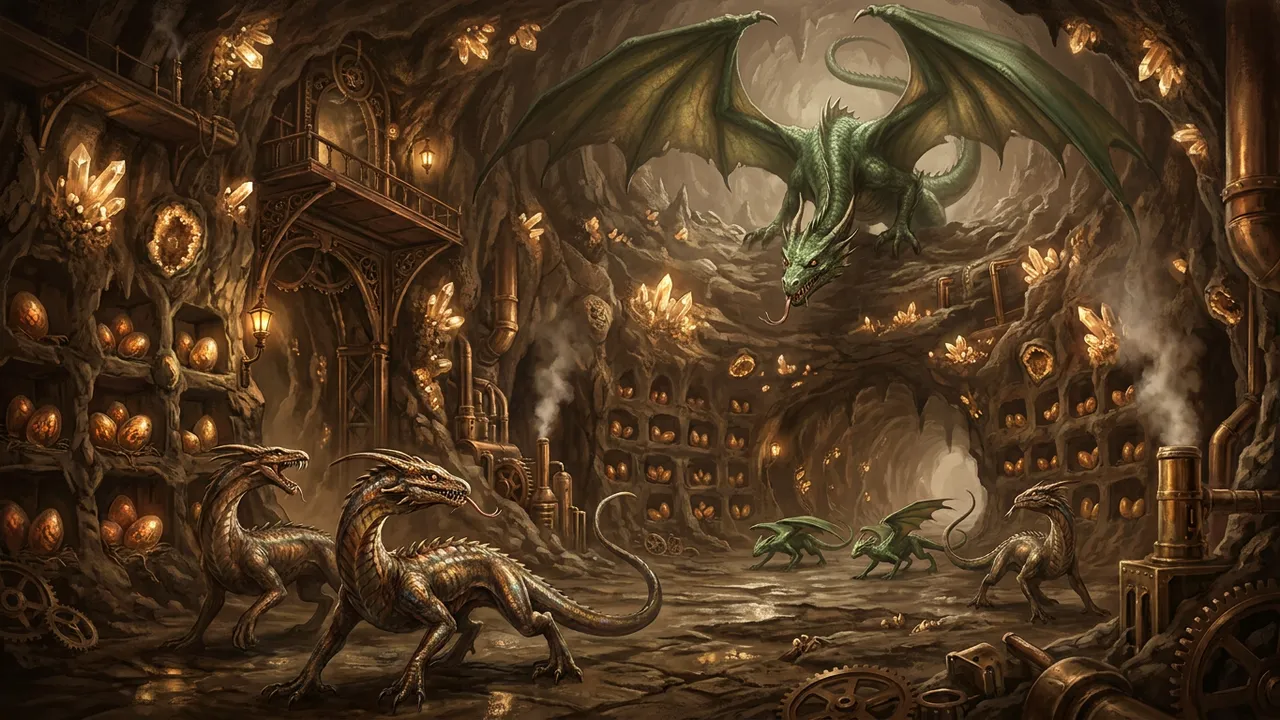
Dragons of the Dragonmist Isles
Spoiler: The Crystal Conspiracy
This section reveals events from “The Crystal Conspiracy”.
Description
The dragons of the Dragonmist Isles are not a uniform population; the creatures observed during the expedition fell into at least three distinct size classes: the common lizard creatures, a large mother dragon, and juvenile dragonets.
Lizard Creatures
Spoiler: The Crystal Conspiracy
This section reveals events from “The Crystal Conspiracy”.
Habitat and Nesting
Spoiler: The Crystal Conspiracy
This section reveals events from “The Crystal Conspiracy”.
Role in The Crystal Conspiracy
Spoiler: The Crystal Conspiracy
This section reveals events from “The Crystal Conspiracy”.
Casualties Inflicted
Spoiler: The Crystal Conspiracy
This section reveals events from “The Crystal Conspiracy”.
In A History of Rislandia
According to A History of Rislandia, the dragons of the Dragonmist Isles are not an isolated curiosity but a remnant population of one of the oldest and most widespread species in the world — creatures whose history stretches back to the age of the Giants and possibly beyond.
Origins and Age
According to A History of Rislandia, dragons are among the oldest creatures in the world, possibly predating even the Giants. The sourcebook offers two competing accounts of their origin: they may have been created directly by the god Pyraleth before his sacrifice, or they may have emerged naturally from the first volcanic fires. The text does not resolve this ambiguity, presenting both as live possibilities within the scholarly tradition.
The sourcebook notes that dragons appear in the legends of every culture from Rislandia to Zenwey to the distant islands of Panderica, though the nature attributed to them varies widely — some traditions portray them as wise teachers, others as mindless beasts, and others as gods incarnate.
Distribution and Habitat
According to A History of Rislandia, the Dragonmist Isles are one of several known dragon habitats. The sourcebook identifies the northeastern volcanic islands as the species' primary domain, with additional populations historically found on volcanic peaks in Zenwey, mountain ranges across the southern continent, remote islands in the frozen north, and deep caverns where fire crystals are concentrated. The underground tropical world of the Dragonmist Isles is explicitly named as a location where dragons still live. The sourcebook also notes that massive bone structures found on the Dragonmist Isles may be ancient dragon remains.
Physical Description and Capabilities
According to A History of Rislandia, dragons are massive reptilian creatures with scaled bodies, long necks, wings, claws, and fangs. The sourcebook states that they vary in size from approximately human-sized as babies to building-sized as full adults. They are described as powerful fliers capable of crossing vast distances, and as nearly invincible in combat. The sourcebook attributes breath weapons to dragons — including fire, ice, acid, or other elemental attacks — and notes that some dragons can use magic or shapeshift. Dragons are also described as difficult to harm with conventional magic.
The novels describe the lizard creatures encountered in the caverns as bulletproof but lacking any described breath weapon, and the mother dragon likewise uses only physical attacks. A History of Rislandia attributes breath weapons and magical ability to dragons as a species; whether the Dragonmist Isles population retains these traits is not addressed by the sourcebook.
Intelligence and Behavior
According to A History of Rislandia, dragons are as intelligent as humans — possibly smarter — and are long-lived, with lifespans of thousands of years and possibly immortal. They are described as capable of speaking multiple languages, hoarding knowledge and treasure as well as crystals, and being arrogant and confident in their superiority. Most prefer solitude, sleeping for centuries at a time, and fiercely defend their territories. Older, stronger dragons dominate younger ones. The sourcebook notes that most encounters between dragons and mortals end badly for the mortals, and that while some dragons will negotiate, the cost is high.
This characterization of dragons as highly intelligent, speaking beings is not reflected in the novel's depiction of the Dragonmist Isles population, which behaves as territorial predators without any demonstrated speech or negotiation.
Relationship with the Giants
According to A History of Rislandia, during the age before the Great Sundering, some dragons entered into a pact with the Giants, serving as mounts and companions. Dragon-riders patrolled the skies as symbols of the Giants' mastery. However, the sourcebook emphasizes that most dragons resented being tamed; only a few formed genuine bonds. Those who bonded with Giants became the most feared warriors in the world. A dragon would serve only one rider in its lifetime and mourn for years after that rider's death. Many dragons remained entirely wild, preferring solitude in mountain lairs. During the Age of Separation, dragons slept in their lairs.
Connection to Crystals
According to A History of Rislandia, dragons are compelled to collect treasure and knowledge, with a particular affinity for crystals. The sourcebook states that dragons are attracted by crystal use and that the dragons of the Dragonmist Isles guard a legendary crystal on the islands. Fire crystals concentrated in deep caverns are listed among the environments dragons naturally inhabit.
Spoiler: The Crystal Conspiracy
This section reveals events from “The Crystal Conspiracy”.
Population Status
Spoiler: The Crystal Conspiracy
This section reveals events from “The Crystal Conspiracy”.