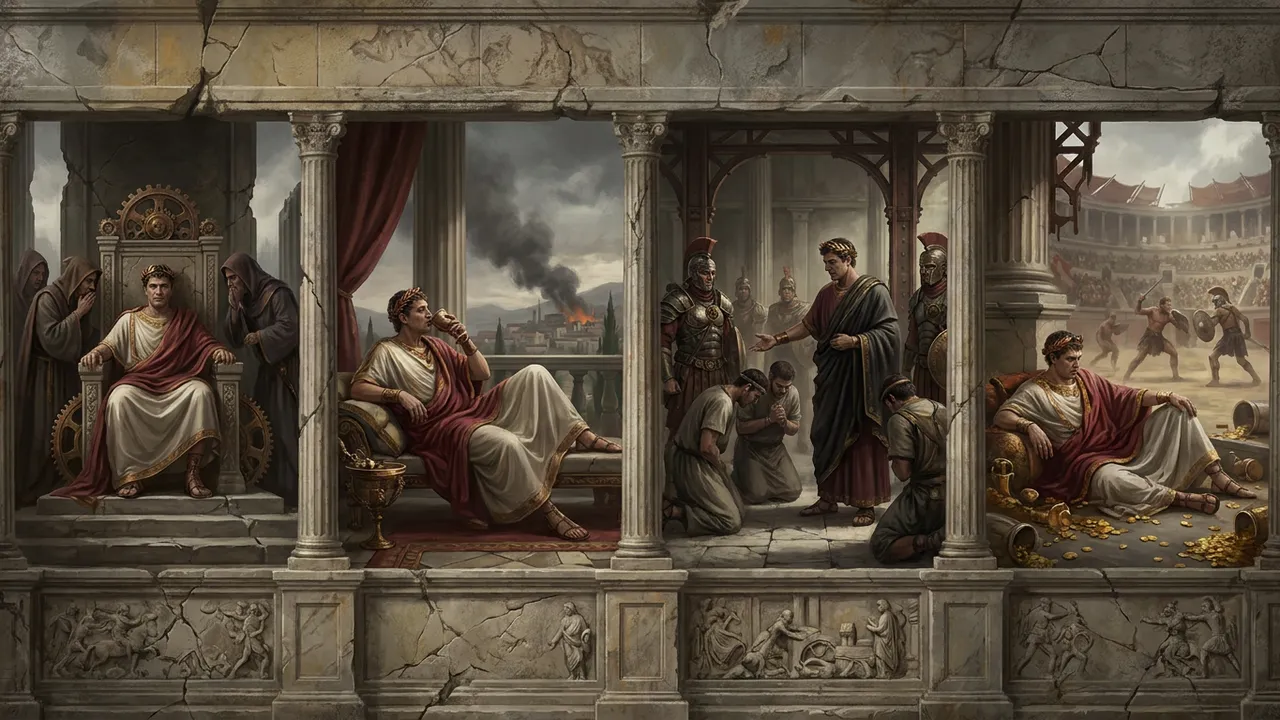
Late Emperors of the Orethan Dominion
The final era of the Orethan Dominion was marked by a succession of emperors whose reigns are collectively characterized in A History of Rislandia as a period of decline. Each ruler, in his own way, contributed to the erosion of imperial authority, civic order, and moral legitimacy that ultimately brought the dominion to ruin. The fall of Oretha and the eventual exodus that gave rise to the Malaky dynasty are inseparable from the failures catalogued in this period.
The approximate dates given below follow the internal chronology of A History of Rislandia and should be understood as scholarly estimates rather than fixed records.
Emperor Aurelius the Blind
Approximate reign: Year ~630
According to A History of Rislandia, Aurelius the Blind was "well-meaning but ineffectual, manipulated by advisors." Despite apparent good intentions, Aurelius lacked the strength of will to govern independently, and those around him exploited that weakness to serve their own ends. His reign drew criticism from High Priest Benedictus III, suggesting that even the Church of the era found his rule wanting.
Aurelius the Blind is notable as the grandfather of Emperor Nerovan the Mad, indicating that the dynasty's instability had deep roots. His inability to assert control over his own court may have set precedents that later emperors proved unable or unwilling to reverse.
Emperor Hadrian the Absent
Approximate reign: Year ~660
Hadrian the Absent earned his epithet through chronic disengagement from the responsibilities of rule. According to A History of Rislandia, he "spent more time at his country villas than in Oretha, ignoring crises." While the empire faced mounting pressures, Hadrian retreated to comfort and leisure, leaving the machinery of governance to stall or collapse without imperial direction.
His reign represents a failure not of malice but of indifference—a ruler present in title only, whose absence from the capital and from decision-making left the dominion vulnerable during a period when strong leadership was most needed.
Emperor Domitian the Cruel
Approximate reign: Year ~690
Where Hadrian had been passive, Domitian the Cruel was actively destructive. According to A History of Rislandia, he "executed perceived enemies without trial, including several bishops." His reign introduced a climate of fear and arbitrary violence into the highest levels of Orethan society. The execution of bishops in particular signalled a willingness to strike at religious authority, destabilizing the relationship between the imperial throne and the Church.
Domitian's cruelty did not strengthen the empire; rather, it hollowed out the institutions and loyalties upon which stable rule depended, accelerating the erosion already underway.
Emperor Gaius the Debauched
Approximate reign: Year ~720
Gaius the Debauched is described in A History of Rislandia as "known for orgies, gladiatorial excess, and neglecting governance." His reign represented a return to the self-indulgence that had characterized earlier periods of imperial weakness, but in a dominion already severely weakened by his predecessors, such neglect carried graver consequences.
Gaius's preoccupation with spectacle and personal pleasure at the expense of statecraft left the Orethan Dominion without meaningful leadership during what may have been its final years of coherence. His reign is often cited as emblematic of the moral and administrative bankruptcy that defined the dominion's closing chapter.
Legacy
Taken together, the late emperors of the Orethan Dominion illustrate a pattern of institutional decay: a well-meaning ruler manipulated by those around him, followed by an absentee, then a tyrant, and finally a hedonist. According to A History of Rislandia, all four are counted among the emperors of decline. Their cumulative failures created the conditions that made the exodus led by Jory Malaky not merely possible but necessary, and their example served as a cautionary foundation upon which the Malaky dynasty and the kingdom of Rislandia were consciously built.