Orethan Dominion
The Orethan Dominion, called by its own citizens the Perennial Empire, stood as the largest and most advanced human civilization the world had ever known. According to A History of Rislandia, it ruled the heart of the Areth continent for nearly a thousand years, governing fifty million souls at its height. The sourcebook describes it as both "humanity's greatest achievement and its greatest tragedy," a civilization that "rose on the backs of guild masters and priests, emperors and commoners" and fell through pride, corruption, and the manipulation of an ancient evil.
Overview
According to A History of Rislandia, the Dominion existed approximately 1,200 to 600 years before the present day of the novels. Its citizens named it the Perennial Empire in the belief that it would endure forever. At its greatest extent it stretched from the Stone Valleys in the northwest to the river deltas of the east, across southeastern deserts, and into southern jungles. The empire rested on three foundational pillars: the Imperial Throne, the Crystal Guilds, and the Church of the Great One. It possessed a golden age of crystal magic and advanced knowledge, and its architectural and guild traditions influenced successor states for centuries.
History
Rise and Golden Age
According to A History of Rislandia, the Dominion's golden age was defined by mastery of crystal magic and a sophisticated guild system that provided intensive training across trades and disciplines. The Imperial Senate participated in governance alongside the throne. Guild halls, palaces, and monumental architecture reflected the empire's wealth and ambition. The sourcebook records that the Dominion governed fifty million souls at its height, a figure unmatched by any subsequent polity on the continent.
Infiltration by Sethran Corvus
The empire's decline was precipitated not by foreign conquest but by infiltration from within. According to A History of Rislandia, the entity known as Sethran Corvus—described as one of the Undying Ones—entered the Dominion in human guise and manipulated events across generations. The sourcebook states: "The Undying One who infiltrated the Orethan Dominion called himself Sethran Corvus." His long campaign of corruption and betrayal hollowed out the empire's institutions before its final collapse.
The Great Sundering and Collapse
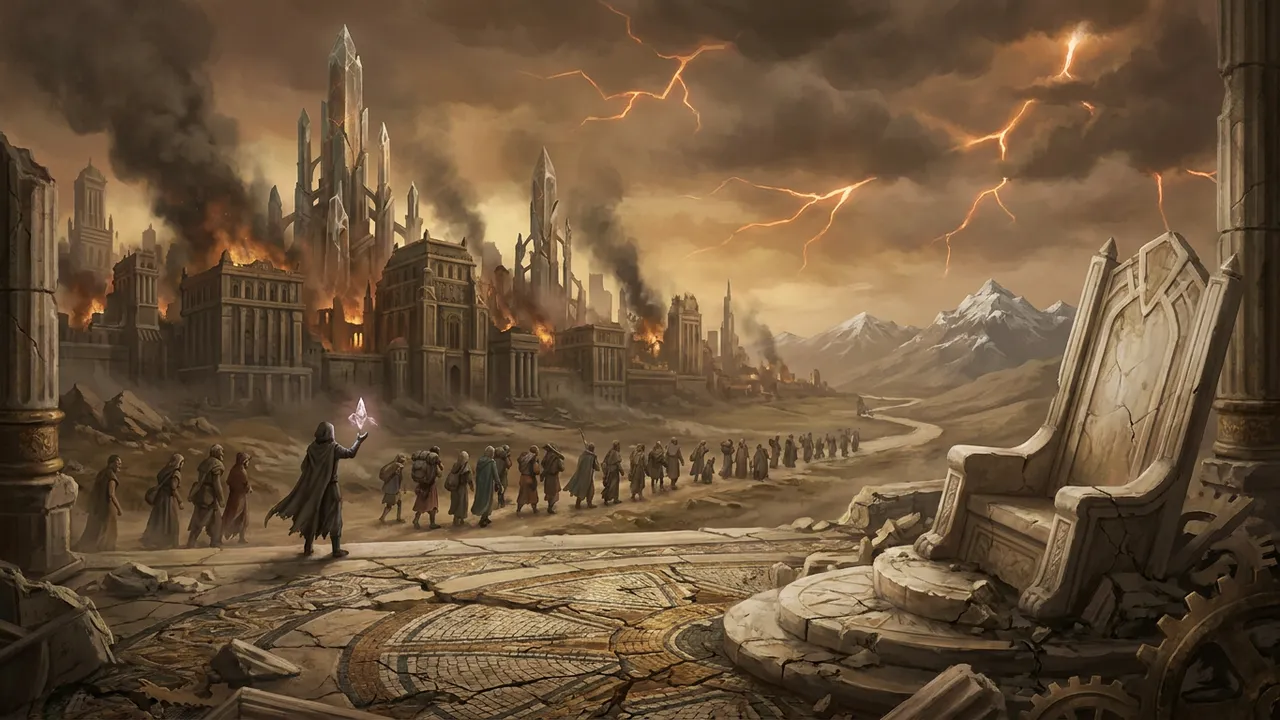
The Dominion ultimately fell in the catastrophe known as the Great Sundering. According to A History of Rislandia, the Sundering weakened humanity's connection to crystal magic and brought the empire to ruin. The collapse was the product of accumulated corruption, internal betrayal, and Sethran Corvus's generational manipulation. The sourcebook characterizes the fall as self-inflicted: the Perennial Empire, which had believed itself eternal, was destroyed by forces it had allowed to fester within.
The Exodus
Following the collapse, survivors fled the ruined heartland. According to A History of Rislandia, Orethan refugees crossed the Oler Mountains in a desperate exodus led by Jory Malaky, eventually founding Rislandia. This exodus became the foundational event of Rislandian national identity and gave rise to the Malaky Dynasty that ruled Rislandia into the era of King Malaky XVI and his daughter Queen Reina I.
Geography
According to A History of Rislandia, the Dominion's territory encompassed a vast and varied landscape: the Stone Valleys to the northwest, eastern river deltas, southeastern deserts, and southern jungles. This breadth made it the dominant power across the Areth continent for the duration of its existence.
Government and Society
The Dominion was governed through three interlocking institutions: the Imperial Throne, the Crystal Guilds (represented by the Guild Council), and the Church of the Great One. An Imperial Senate also participated in governance. The guild system provided rigorous training and formed the backbone of the empire's economic and intellectual life. According to A History of Rislandia, this old guild system later served as the model for successor institutions, including the Knights of the Crystal Spire, which were modeled on old Orethan elite guilds.
Crystal Magic
The Dominion's golden age was inseparable from its command of crystal magic. According to A History of Rislandia, the Great Sundering weakened humanity's connection to this power, and the knowledge of the golden age was largely lost with the empire's fall. Magistra Lyria of the Chronists was described in the sourcebook as "the last direct link to the Orethan Dominion's golden age"; her death ended that living connection entirely. The Crystal Spire incorporated ancient architectural principles derived from the Dominion.
Fragmentation and Successor States
According to A History of Rislandia, the Dominion's collapse fragmented the continent into the modern kingdoms: Atrebla, Perryton, Nyanzi, Rescall, Zarma, and Wyn. Both Rislandia and the Wyranth Empire claimed descent from the Orethan refugees and styled themselves the "true heir" of the old empire. Rislandian schools formally taught that Rislandia held this distinction, a claim that informed the long rivalry between the two powers.
Legacy
The memory of the Orethan Dominion permeated Rislandian culture, law, and identity. According to A History of Rislandia, the experience of the empire's fall—particularly the memory of Sethran Corvus and the purges associated with his influence—instilled a deep fear of tyranny in the Rislandian national character. The Malaky Dynasty traced its legitimacy to the exodus from the Dominion, and Founding Day commemorated the refugees' arrival and the establishment of the new kingdom. The sourcebook records that the Dominion's collapse "shaped Rislandian identity" in ways still visible in the reign of King Malaky XVI.
The sourcebook A History of Rislandia closes its account of the Dominion with the observation that it was called the Perennial Empire "for they believed it would last forever"—a belief the Great Sundering proved catastrophically wrong.