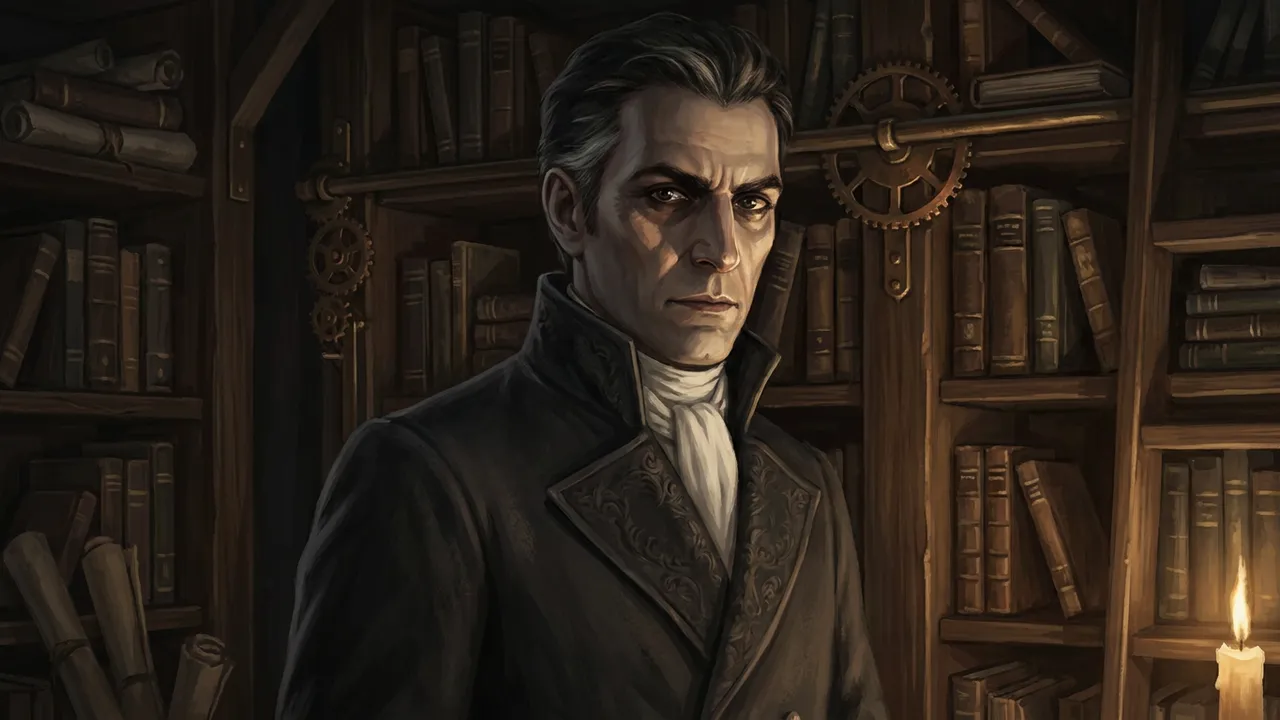
Sethran Corvus
Sethran Corvus, also known by the epithet The Undying One, was among the most consequential and least visible figures in the history of the Orethan Dominion. According to A History of Rislandia, "Sethran Corvus" was almost certainly not his true name. He is classified among the Undying Ones, beings of apparent immortality who moved through mortal history pursuing long-term designs invisible to those around them.
Description
Sethran Corvus presented himself as a middle-aged man of unremarkable appearance. He had dark hair graying at the temples, pale skin suggesting a life spent largely indoors, and, most notably, dark, penetrating eyes that, as A History of Rislandia records, "seemed to see through lies." He dressed in fine but not ostentatious clothing and carried himself with a soft-spoken, persuasive, and charming manner. He claimed to be a scholar from a distant province, an expert in history and philosophy — a cover made plausible by the fact that his knowledge was vast because, as the source notes, he had lived through much of the history he discussed.
History
Early Infiltration of the Orethan Dominion
According to A History of Rislandia, Sethran Corvus first appeared in Oretha during the reign of Emperor Augustan II, approximately 780 years before the present day. He presented himself to the Senate of the Orethan Dominion as a consultant offering advice on economic matters. Over time, he advised senators on legislation, always subtly working to undermine the unity of the empire rather than strengthen it. He simultaneously cultivated relationships with the Orethan Dominion Guild Masters, encouraging rivalries among them and promoting research into blood magic.
Operating through proxies and never revealing the full extent of his influence, Corvus whispered to emperors, feeding their paranoia and greed across successive reigns.
The Grooming of Nerovan
Corvus's most consequential act was the deliberate grooming of the man who would become Emperor Nerovan the Mad. According to A History of Rislandia, Corvus became the young Nerovan's tutor, shaping his worldview from childhood. When Nerovan ascended to the throne, he appointed Corvus as First Advisor with unprecedented authority. From that position, Corvus attended all imperial meetings, controlled access to the emperor, drafted legislation in Nerovan's name, and commanded the Shadowkin. In effect, he ruled the empire with Nerovan as his puppet.
Fabrication and the Fall
To consolidate Nerovan's grip and eliminate potential opposition, Corvus fabricated evidence of a guild rebellion and staged an assassination attempt on the emperor, using a patsy drawn from the Windcallers' Brotherhood. These acts accelerated the cycle of purges and instability that characterized Nerovan's reign.
Following the death of Nerovan and the Fall of Oretha, Corvus vanished. A History of Rislandia notes that some accounts hold he simply walked away, satisfied with his work. Whether he perished in the collapse or survived to pursue new schemes elsewhere remained, at the time of the source's composition, unresolved: "some believe he died; others believe he still walks the world pursuing new schemes."
Character and Methods
A History of Rislandia characterizes Corvus as a "patient evil," observing that "patient evil is the most dangerous kind." His methods were consistent across his long career: he never acted openly, always worked through intermediaries, cultivated personal relationships to exploit, and allowed institutions to destroy themselves from within rather than attacking them directly. His claim to scholarly expertise served as both cover and tool, granting him access to the powerful while deflecting suspicion.
Legacy
The memory of Sethran Corvus and the purges associated with his influence became a lasting element of Rislandian political consciousness. According to A History of Rislandia, fear of tyranny in Rislandia is shaped in part by the collective memory of Corvus and the destruction he wrought upon the Orethan Dominion. His name became a cautionary reference point for the dangers of unchecked advisors, hidden manipulation, and the slow erosion of institutional unity.