Legends and Folklore of Areth
The continent of Areth produced a diverse tradition of legend and folklore, preserved across its many cultures and regions. According to A History of Rislandia, these stories ranged from coastal sailors' tales to rural warnings for children, and from widespread Fae myths to geologically rooted mountain legends. Many served explicit moral or cautionary purposes, and at least one was believed by the sourcebook's author to have originated from a real incident that was later embellished in the retelling.
Overview
The legends of Areth fell broadly into several thematic categories: bargains with powerful supernatural beings, the dangers of the Fae, threats posed by were-creatures, and the sleeping power of dragons. Coastal communities, inland rural settlements, and mountain peoples each developed their own regional traditions, though certain stories—particularly those involving the Fae—spread across nearly every culture on the continent.
Dragon Legends
The Dragon's Bargain
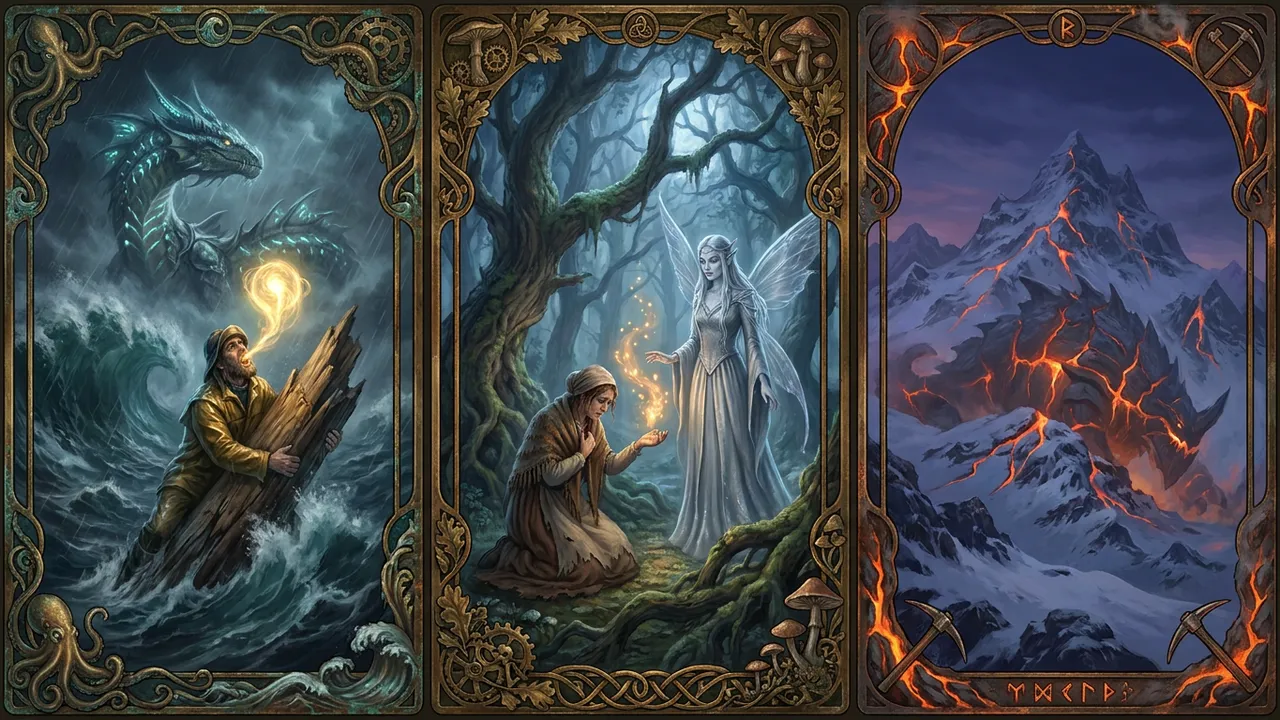
According to A History of Rislandia, "This story is told in coastal regions, particularly Portsgate and Perryton, where sailors claim to have seen dragons flying over the ocean." The tale centered on a fisherman named Torin, who was caught in a terrible storm that smashed his boat to pieces. Clinging to driftwood and nearly drowning, Torin made a bargain with a sea dragon: his voice in exchange for being carried safely to shore.
The sourcebook recorded that Torin felt "something pulled from his throat—not painful, but strange, like a thread being drawn out." His voice departed as a glowing orb, which the dragon swallowed. Torin was carried to shore and survived, but could never speak again for the rest of his life. He communicated thereafter through gestures and writing, and though he lived long, he was said to have been haunted by the loss. Sailors in later generations reported hearing a beautiful, sad voice over the ocean, which they attributed to Torin's voice still singing inside the dragon's belly.
The legend carried an explicit moral warning about making promises to powerful beings and the permanent, irrevocable cost of such bargains. Some regional variations softened the tale: in certain versions, Torin tricked the dragon, or the dragon eventually returned his voice. The core version, however, preserved the permanence of the loss as its central lesson.
The Sleeping Dragon Beneath the Mountain
A legend specific to the Oler Mountains region of Rislandia, this story featured the dragon Volcareth, said to sleep beneath the mountains themselves. According to A History of Rislandia, "This legend is told in the Oler Mountains region of Rislandia and may explain certain geological phenomena." The legend included a prophecy that Volcareth would wake in the world's darkest hour. The sourcebook referenced this legend in Chapter 3 and suggested it may have served as a folk explanation for seismic or volcanic activity in the region.
Fae Legends
The Fae's Bargain: The Tale of the Desperate Mother
According to A History of Rislandia, "This story is told across Rislandia and serves as a warning about making deals with the Fae." The tale featured a woman named Mira, her son Tam, and a Fae woman. In order to save Tam's life, Mira gave away her son's first laugh to the Fae. The story was told across Rislandia and belonged to a broader category of legends the sourcebook described as "stories of mothers trading laughter for their children's lives."
The Stolen Child
According to A History of Rislandia, the legend of the Stolen Child was "one of the most widespread Fae legends, told in nearly every culture with variations." The tale featured a couple whose child was taken by the Fae and replaced with a changeling—a Fae child disguised to resemble the stolen human infant. The sourcebook described changelings as growing "sickly and strange" before eventually returning to the Fae, leaving the parents with nothing.
The sourcebook recorded two distinct characterizations of changelings: as "A Fae child, disguised to look like your own," and separately as "Humans who have been altered by Fae magic" who inhabit the Islands of Fae. These two descriptions may represent different regional variants of the legend or distinct phenomena within the world's lore.
Were-Creature Legends
The Cottage in the Woods
According to A History of Rislandia, "The story of 'The Cottage in the Woods' likely originated from a real incident" involving were-creatures, and was subsequently embellished to serve as a warning. The tale was told in rural regions of Rislandia, particularly near the Old Forest, and cautioned children against wandering into the woods alone.
The story featured a were-creature that lured travelers with the promise of shelter. A distinctive element of the legend was that the cottage itself moved and was never found in the same place twice, making it impossible for victims to avoid or for rescuers to locate. The sourcebook's suggestion that the legend had a basis in real events lent it a different character from purely mythological tales, implying that encounters with were-creatures in or near the Old Forest were not unknown in Rislandia's history.
Themes and Social Function
Across their regional variations, the legends of Areth shared several recurring themes. Bargains with supernatural beings—whether dragons or the Fae—were consistently portrayed as dangerous and costly, with the permanent loss of something precious serving as the standard consequence. Fae legends in particular emphasized the vulnerability of children and the grief of parents, functioning as both cautionary tales and expressions of cultural anxiety about the Fae's power over human life.
The Cottage in the Woods legend demonstrated that folklore also served a direct protective function, discouraging behavior—such as children wandering alone near dangerous areas—that carried genuine risk. The sourcebook's note that this story likely originated from a real incident suggested that at least some Arethan folklore preserved cultural memory of historical dangers in narrative form.