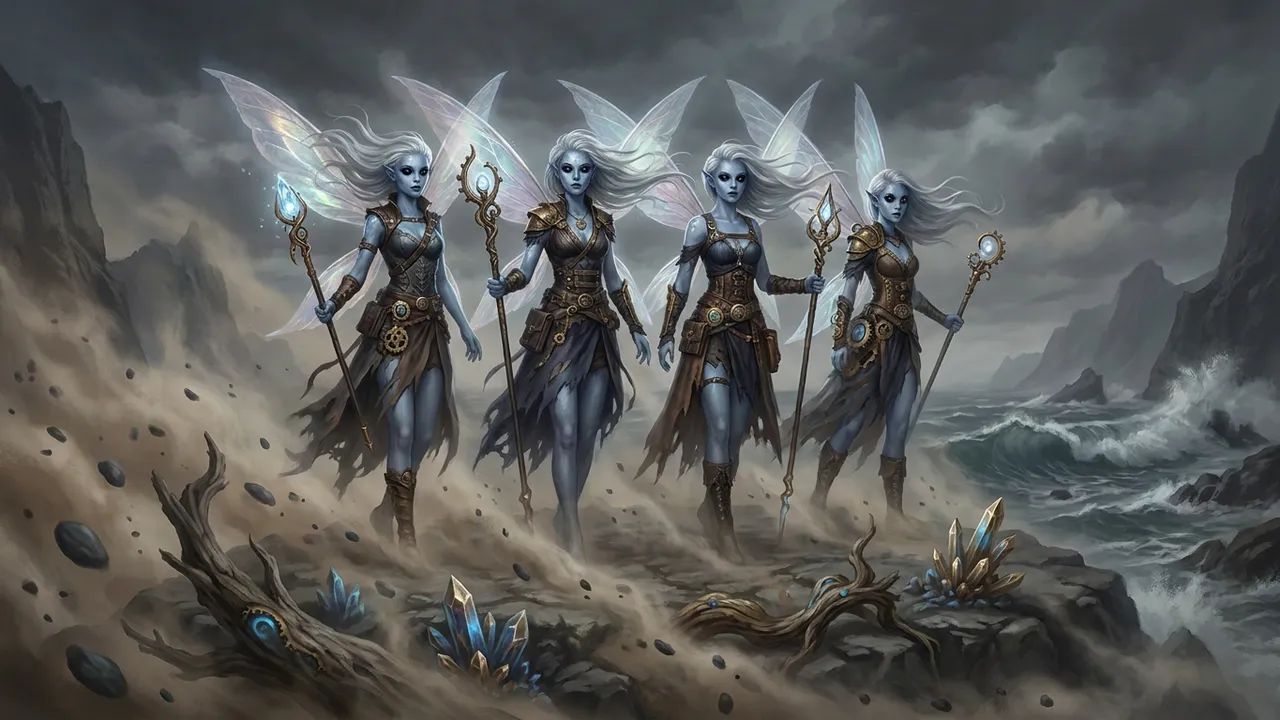
The Fae
The Fae are timeless, otherworldly beings that manifest in hidden places across the world. They are neither fully mortal nor fully spirit.
Origin
Born from Vitarum's Life Crystals merging with Chronazel's Fate Shards.
Characteristics
- Appearance: Beautiful, with wings, obsidian eyes, and blue-grey skin
- Cannot Lie: Bound by ancient laws, but masters of deception through careful truth
- Bargains: Deals are magically binding and cannot be broken
- Powers: Time manipulation, shapeshifting, illusion, teleportation
Where They Dwell
- Islands of Fae (Oslan and others) in the Golgmarsh Ocean
- Deep forests across both continents
- Sacred groves and hidden valleys
- Places where multiple crystal types converge
Encounter with Baron von Monocle
Theodore traded Harkerpal's electrical field defense system for aether fuel and left Count Eberle's son with the Fae, as the boy was genuinely happy and safe among them.
Courts
Rumored to have courts of Summer and Winter (Seelie and Unseelie), though their true structure is unknown to mortals.
In the short stories
In Island of the Fae, four Fae confront Theodore's landing party. They are female, nude, blue-grey and winged, with obsidian eyes, and they speak in chorus. They kill Private Russell with silent darts, raise a sandstorm, and hold Count Eberle's twelve-year-old son, whom they call "the progeny". When Theodore traps them in Harkerpal's electrical field, they offer their "lifesblood", which is aether fuel, rather than give up the boy. When he releases them, they say he "chose wisely".
In A History of Rislandia
According to A History of Rislandia, the Fae are among the most mysterious beings in the world, appearing in the folklore of every human culture under different names. The sourcebook refers to them also by the alias "The Timeless Ones".
Physical Description
While the novel-based account on this page describes the Fae as having blue-grey skin, A History of Rislandia describes their skin as being "like moonlight" and their eyes "like stars" — a poetic formulation that differs from the blue-grey skin and obsidian-eye description given in the novels. The sourcebook does confirm obsidian black eyes with no whites, and adds that they possess delicate, translucent wings that blur when in motion, and small but sharp fangs suggesting a predatory nature. Their presence is described as cold and ethereal, as if not fully present in the physical world.
Origins and Nature
A History of Rislandia confirms that the Fae were born from Vitarum's Life Crystals merging with Chronazel's Fate Shards, and that they are neither fully mortal nor fully spirit. The sourcebook elaborates that they manifested specifically in places where the boundary between the physical and spiritual worlds was thin. They do not age as mortals do and may be immortal. The sourcebook states that Fate Crystals are found predominantly in Fae territories.
Memory and Knowledge
According to A History of Rislandia, the Fae remembered The First Song and knew the true names of the Firstborn — but did not share this knowledge freely. This positions them as living repositories of the world's oldest history, predating human civilisation.
Relationship with Other Beings
The sourcebook notes that the Fae occasionally interacted with the Giants, always as equals — a detail not found in the novels. They appeared in the folklore of every human culture by different names, and some Fae were benevolent while others were capricious or cruel. The sourcebook emphasises that even benevolent Fae could be harmful due to their fundamentally alien nature, and that they are "not evil, but not kind."
Values and Motivations
A History of Rislandia provides significant detail on Fae psychology absent from the novels. The Fae are said to value abstract things — laughter, memories, and names — more than material wealth. They envy mortals because mortal lives are short, bright, and full of change and meaning. They value bargains, mystery, beauty, art, music, and freedom, and deeply resent being bound or controlled. They are fascinated by human children, sometimes taking children and raising them in their realm, and may replace human children with Fae offspring called Changelings.
Bargains
The sourcebook confirms that Fae bargains are magically binding and cannot be broken, and adds that the Fae will honour a bargain even if it costs them greatly. It warns that the cost of a deal is often more than the mortal party expects. The Fae will pursue those who betray them.
Habitat and Territory
A History of Rislandia confirms the Fae dwell on certain islands in the western ocean, in deep forests, sacred groves, hidden valleys, and places where multiple crystal types converge. The sourcebook adds that the Fae claimed some islands in the Far Northern Islands, with some of those islands becoming dominated by Fae rather than humans. They are also said to dwell in the Whispering Grove within the Old Forest, where local legends treat them as dangers. Sailors additionally report seeing beautiful, otherworldly beings in the jungle of Isle du Mystere, and the Fae are rumoured to inhabit that island. The sourcebook notes that time flows differently in Fae lands and that Fae circles found in the wilderness are dangerous to enter.
During the Age of Separation, the Fae remained hidden but occasionally interacted with mortals.
The Islands of Fae and Royal Decree
According to A History of Rislandia, the Islands of Fae are off-limits by royal decree in Rislandia. The sourcebook records that an entire airship crew disappeared at the Islands of Fae in Year 438 — a prior incident that predates Baron Theodore von Monocle's own encounter. The sourcebook records Baron von Monocle's successful bargain with the Fae as occurring in Year 3 of King Malaky XVI's reign. The sourcebook also states that the Fae have not been seen in Rislandian territory recently.
Courts
A History of Rislandia confirms the rumour of Fae courts of Summer and Winter (Seelie and Unseelie), consistent with what the novels suggest, but notes that the Fae do not share their internal hierarchy with outsiders.
Fae Circles
The sourcebook associates the Fae with Fae circles found in wilderness areas, describing them as dangerous to enter — a detail not addressed in the novels or the novel-based account on this page.