The Goblin in the Well (Legend)
"The Goblin in the Well" is a children's warning tale widely told by parents across Rislandia. According to A History of Rislandia, it was particularly popular in places such as Plainsroad Village and the city of Loveridge, and served the moral purpose of teaching children not to trust strangers and to remain close to home. The tale is referenced in Chapter 3 of that work.
Origins
According to A History of Rislandia, the tale likely originated from a real incident and was embellished over generations of retelling. The text does not specify when or where the original event occurred, nor does it name a date of composition for the story's earliest recorded form.
Synopsis
The tale centers on a girl named Elara and a goblin named Pip. Elara was described as a curious child who explored the fields and forests around her home, much to her mother's worry. Her mother had warned her to stay close to the house and never to speak to strangers.
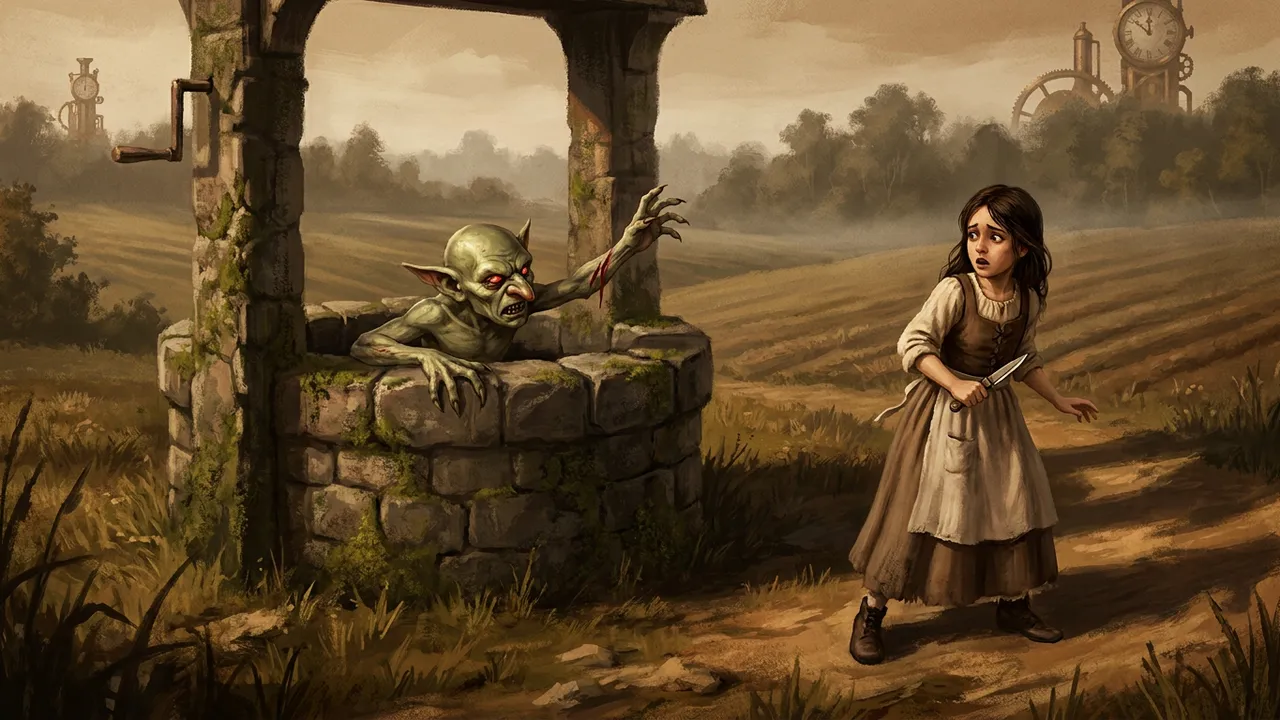
One day, Elara discovered an old abandoned well at the edge of her village. Pip, concealing himself within the well, lured her downward by pretending to be a trapped child. Once Elara drew close enough, Pip seized her ankle with an iron-like grip. Elara, who carried a small blade in her pocket for cutting apples — a knife her father had given her — slashed Pip's hand with it. Pip released her, and she ran home and told her mother what had happened.
Afterward, the men of the village sealed the well. Pip was never found.
Characters
Elara
Elara was the young protagonist of the tale. According to A History of Rislandia, "She was a curious child, always exploring the fields and forests around her home, much to her mother's worry." Her mother had instructed her to stay near the house and avoid strangers. Elara habitually carried a small knife given to her by her father, used ordinarily for cutting apples. This knife proved decisive in her escape from Pip.
Pip
Pip was the goblin antagonist of the tale. According to A History of Rislandia, "He was a goblin, small and twisted, with sickly green skin that sagged and wrinkled, long fingers ending in black claws, long ears that bent, and evil red eyes that glowed like embers in the dark." His mouth was described as too wide and filled with too many teeth. In his true voice, Pip spoke in a wet hissing sound, though he disguised this voice to mimic a trapped child in order to lure Elara. After being slashed on the hand by Elara's knife, Pip released her. He was never found after the village men sealed the well.
Regional Variants
According to A History of Rislandia, the tale existed in several distinct regional forms:
- Standard Rislandian version: Elara escapes by wounding Pip with her knife, as described above.
- Alternate Rislandian version: In some tellings, Elara does not escape and becomes a cautionary figure herself rather than a survivor.
- Atreblan version: In Atrebla, the goblin Pip is replaced by a "shadow-man" or "cave-dweller," reflecting local folklore traditions.
- Wyranth version: In Wyranth Empire tellings, Elara kills the goblin outright and is celebrated as a hero rather than merely a survivor.
- Sympathetic version: In some tellings, Pip is portrayed not as malicious but simply as hungry, softening the tale's moral.
Themes and Purpose
According to A History of Rislandia, the tale functioned primarily as a warning to children: "This tale is told by parents across Rislandia to teach children not to trust strangers and to stay close to home." The existence of variants in which Elara does not escape suggests the tale was also used in some communities as a starker cautionary example, while the Wyranth variant repurposed the story to emphasize martial courage.
Legacy
The tale's broad geographic distribution — from rural Rislandian villages to Atrebla and the Wyranth Empire — indicates it held a place in the shared cultural fabric of the peoples of Areth. Its inclusion in A History of Rislandia alongside other legends of the continent suggests it was regarded by Rislandian scholars as part of the broader tradition of Legends and Folklore of Areth.