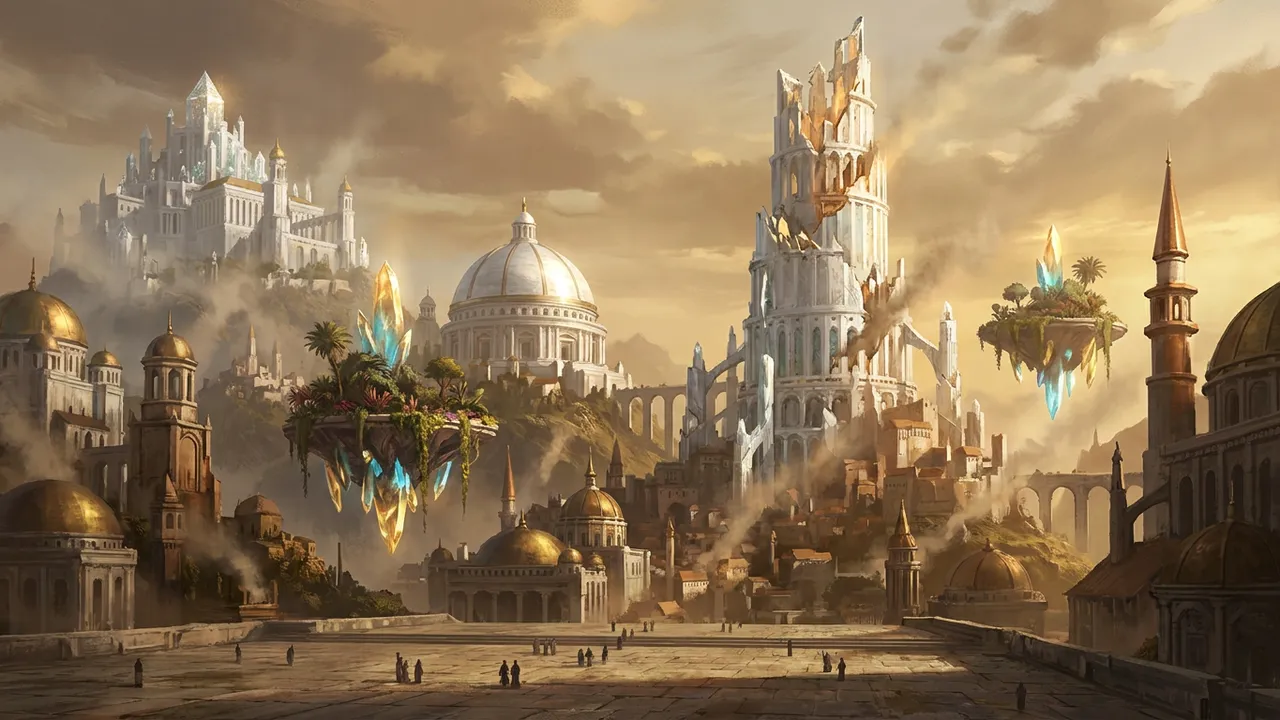
Landmarks of Oretha Eternal
Oretha Eternal, the imperial capital of the Orethan Dominion, was renowned throughout the ancient world for its monumental architecture, crystal-enhanced engineering, and the ordered grandeur of its seven hills. According to A History of Rislandia, the city's landmarks reflected the full scope of Orethan civilization — its faith, governance, scholarship, commerce, and military power. Many of these structures were damaged or lost entirely during the Great Sundering, and their memory was preserved largely through the scholars and Chronists who fled with Jory Malaky during the Great Exodus.
The Seven Hills
According to A History of Rislandia, Oretha Eternal was built across seven hills, each associated with a distinct function of imperial life.
Palatine Hill
Palatine Hill was the seat of imperial authority and the most prestigious of the seven hills. It was the site of the Imperial Palace, described in A History of Rislandia as "a sprawling complex of white marble and crystal." The palace served as the residence and administrative center of the Orethan emperors throughout the Dominion's history.
Capitoline Hill
Capitoline Hill served as the spiritual heart of Oretha Eternal. It was the site of the Great Temple of the One, described in A History of Rislandia as "the seat of the High Priest." The hill thus united religious and ecclesiastical authority in a single elevated precinct.
Aventine Hill
Aventine Hill housed the Guild Quarter, where the Seven Great Guilds maintained their halls. According to A History of Rislandia, this district was the center of craft, commerce, and organized labor within the Dominion.
Quirinal Hill
Quirinal Hill was the administrative and legislative center of the city. A History of Rislandia identifies it as the site of the Senate House and associated government buildings, making it the seat of the Orethan Senate.
Viminal Hill
Viminal Hill was home to the Grand Library, described in A History of Rislandia as "containing centuries of accumulated knowledge." The hill served as the intellectual center of the Dominion and was the headquarters of the Chronists guild. Approximately one thousand scholars from the Grand Library and associated academies were among the refugees who gathered at Petra Magna during the Great Gathering.
Esquiline Hill
Esquiline Hill comprised the wealthy residential district of Oretha Eternal. According to A History of Rislandia, it was home to the estates of nobles and guild masters, reflecting the concentration of private wealth and social prestige in this quarter of the city.
Caelian Hill
Caelian Hill was the military district of the capital. A History of Rislandia records it as the site of the military barracks and training grounds, where the Dominion's armed forces were garrisoned and drilled.
Public Spaces and Civic Monuments
Forum Imperialis
The Forum Imperialis was a vast public plaza at the heart of Oretha Eternal. According to A History of Rislandia, it was "paved with seamless stone (shaped by Stonemasons), where citizens gathered for speeches, markets, and festivals." The Stonemasons' Covenant was responsible for the seamless stonework that distinguished the Forum from ordinary construction.
Celestial Amphitheater
The Celestial Amphitheater was one of the largest public venues in the ancient world. A History of Rislandia records that it seated one hundred thousand people and was used for games, theater, and religious ceremonies.
Floating Gardens
The Floating Gardens were among the most celebrated wonders of Oretha Eternal. According to A History of Rislandia, they consisted of platforms suspended by air crystals, upon which rare plants grew in mid-air. The Gardens were destroyed during the Great Sundering; A History of Rislandia states plainly that "the Floating Gardens crashed to the ground."
Imperial Spire
The Imperial Spire was a tower of white marble and crystal rising four hundred feet above the city. A History of Rislandia describes it as serving "as both watchtower and beacon of imperial power," with crystal reinforcements that made it visible for miles. During the Great Sundering, "the Imperial Spire's crystal reinforcements shattered, causing portions of the tower to collapse."
Religious Landmarks
Great Temple of the One
The Great Temple of the One stood on Capitoline Hill and served as the headquarters of the Church of the Great One. According to A History of Rislandia, it was "a magnificent domed structure of white marble," its interior adorned with mosaics depicting the creation of the world, the sacrifice of the Firstborn, and the promise of redemption. The Temple contained four principal interior spaces:
Hall of Sacrifice
The Hall of Sacrifice was the primary liturgical space within the Great Temple, where the High Priest conducted mass.
Chamber of Confession
The Chamber of Confession was where priests heard confessions and offered forgiveness to the faithful.
Library of Saints
The Library of Saints contained records of holy men and women who, according to A History of Rislandia, "exemplified virtue."
Catacombs
Beneath the Great Temple lay the Catacombs, which served as burial places for saints, cardinals, and High Priests of the Church.
Guild Landmarks
Grand Guild Hall
The Grand Guild Hall was the principal seat of guild authority in Oretha Eternal. It is most prominently recorded in connection with the Night of Shattered Crystals, during which A History of Rislandia states that "the Grand Guild Hall was surrounded at midnight." Guild masters were arrested there; most were killed on the spot. Apprentices and journeymen were given the choice to swear loyalty or die, and the hall was subsequently ransacked and its crystals confiscated.
Legacy
The landmarks of Oretha Eternal endured in the memory of the Orethan diaspora long after the city's fall. Scholars, Chronists, and clergy who survived the Great Sundering carried knowledge of these places into exile, and their accounts formed the basis of the relevant sections of A History of Rislandia. The Grand Library's scholars in particular ensured that records of the city's architecture, institutions, and sacred spaces were preserved for future generations, eventually informing the cultural and religious foundations of Rislandia.