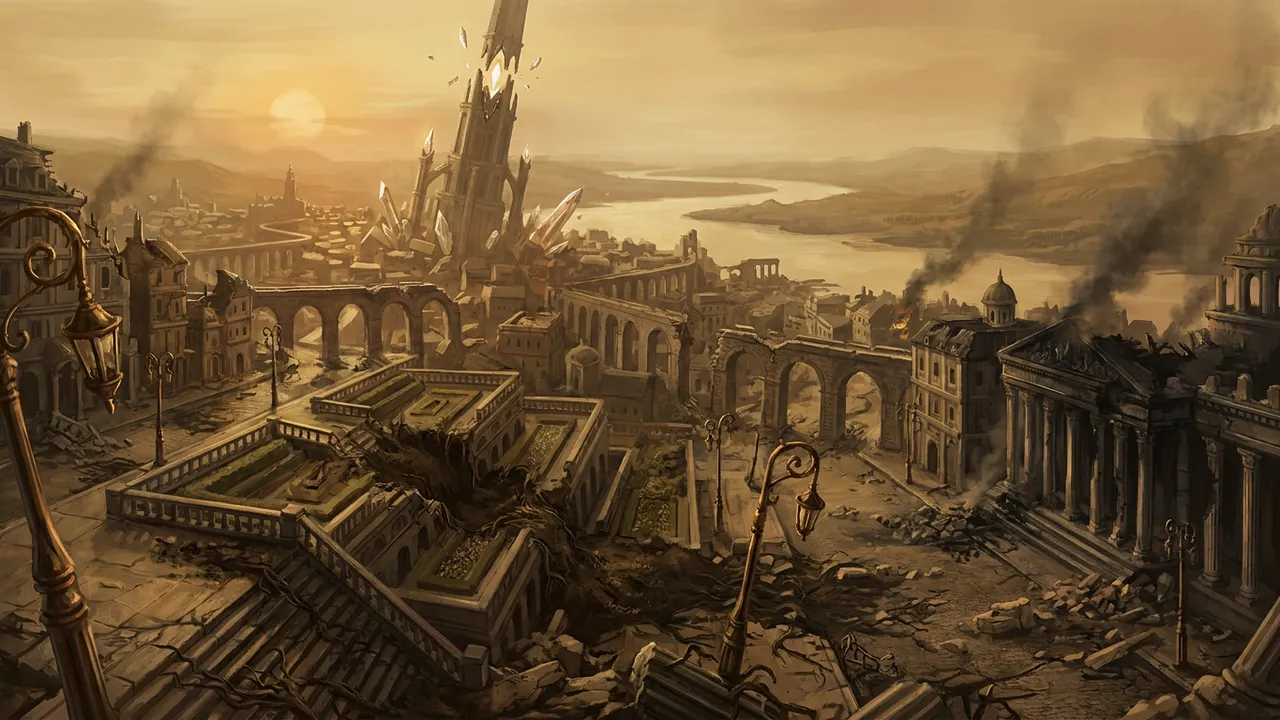
Oretha Eternal
Oretha Eternal, referred to simply as Oretha by its inhabitants, was the capital city of the Orethan Dominion and, according to A History of Rislandia, the largest city in the known world at the height of its power. Its fall is treated by historians as one of the defining catastrophes of the ancient era.
Overview
According to A History of Rislandia, Oretha Eternal was "built on seven hills along the River Aurion in the central plains." Its population exceeded two million at its peak, a figure that dwarfed any other known settlement of the age. The city served as the political, cultural, and institutional heart of the Orethan Dominion, housing the imperial palace, the Grand Guild Hall, and the headquarters of the Chronists guild.
Description
Oretha Eternal was renowned for its advanced infrastructure and crystal-powered amenities. According to A History of Rislandia, the city's streets were lit by crystal lamps, and it possessed underground sewers constructed by the Stonemasons' Covenant. Automated water fountains powered by life crystals provided fresh water throughout the city, while heated baths were warmed by fire crystals. Among its most celebrated features were the Floating Gardens, which hung above the city until their destruction during the Great Sundering.
The Grand Guild Hall stood as a central institution of civic and guild life, and the Imperial Spire — reinforced with crystals — dominated the city's skyline. The Aurion Aqueduct further supported the city's vast population. For a full catalogue of the city's known landmarks, see Landmarks of Oretha Eternal.
History
Height of Power
During the era of the Pax Orethan, Oretha Eternal functioned as the undisputed centre of civilisation on the continent of Areth. The Chronists maintained their guild headquarters within the city, and the Guild Council convened at the Grand Guild Hall. The city's crystal-powered infrastructure represented the pinnacle of Orethan engineering.
Decline Under the Late Emperors
According to A History of Rislandia, bread riots became common in Oretha during the reigns of the late emperors. Emperor Hadrian the Absent — listed among those rulers — spent more time at country villas than in the capital, leaving the city without effective imperial governance. It was during the reign of Emperor Augustan II that Sethran Corvus first appeared in Oretha, an event whose significance would only become apparent later.
The Night of Shattered Crystals
A pivotal moment in the city's unravelling came during the Night of Shattered Crystals, when the Grand Guild Hall was surrounded at midnight. A History of Rislandia records this event as a turning point in the collapse of institutional order within the Dominion.
The Great Sundering and the Fall
The Great Sundering brought catastrophe to Oretha on a scale from which it never recovered. According to A History of Rislandia, the Floating Gardens crashed to the ground, and the crystal reinforcements of the Imperial Spire shattered, causing portions of the structure to collapse. In the aftermath, the city descended into food shortages, riots, disease, fires, and gang violence.
In approximately Year 589 Before Present, a mob stormed the imperial palace. Emperor Nerovan the Mad was dragged into the streets and torn apart by the crowd. A History of Rislandia records that "The Undying One vanished after the Fall of Oretha," referring to Sethran Corvus, who disappeared following the city's collapse. The Fall of Oretha marked the effective end of the Orethan Dominion as a functioning state.
Legacy
The memory of Oretha Eternal endured long after the city's destruction. The exodus led by Jory Malaky and the subsequent founding of the Malaky Dynasty in Rislandia drew heavily on Orethan institutional traditions, including guild structures and crystal technology. Scholars writing in the tradition of A History of Rislandia regarded Oretha as the standard against which all later cities were measured — a civilisation whose loss defined the shape of the world that followed.