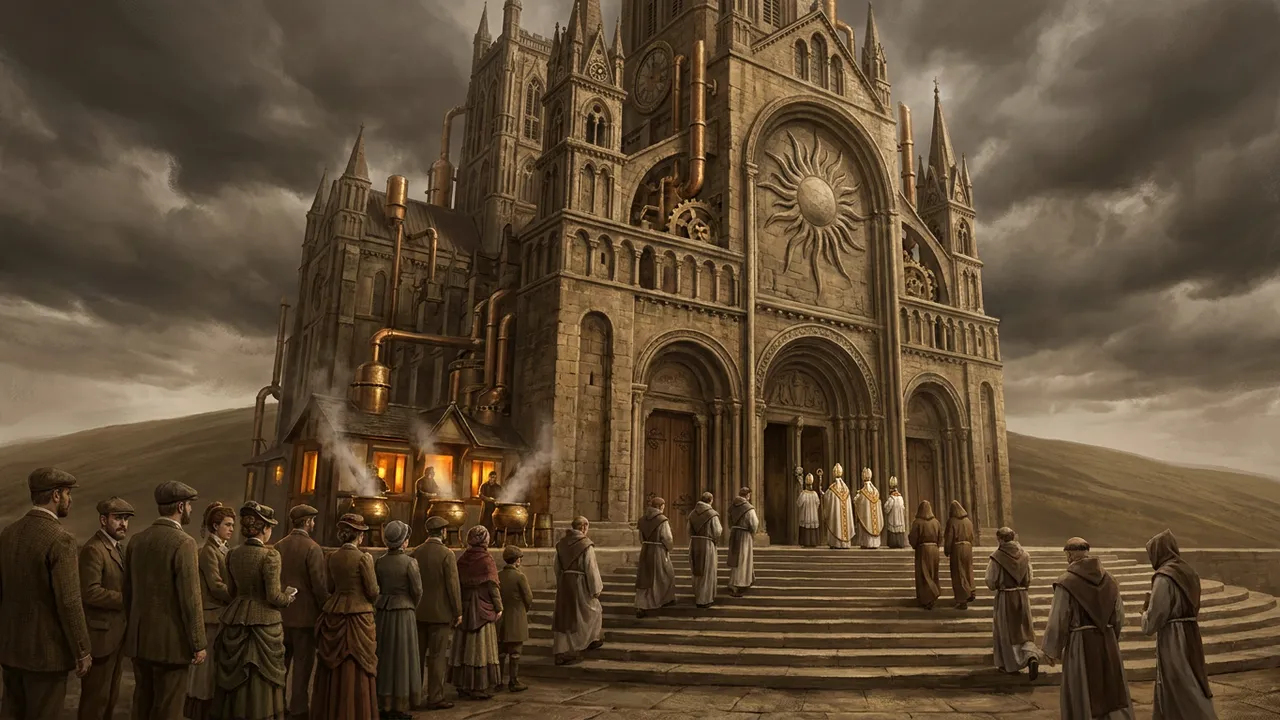
Church of the Great One
The Church of the Great One was one of the oldest and most consequential religious institutions in the history of Rislandia and the broader world of Areth. Founded as a pillar of the Orethan Dominion, it survived the Great Sundering, accompanied the refugees of the Great Gathering into exile, and shaped the early culture and governance of Rislandia before being dismantled by royal decree. Even after its suppression, its core values persisted in Rislandian society.
Theology and Doctrine
The Church worshipped a deity known as the Great One, whom it taught had created the world through sacrifice. According to A History of Rislandia, the Great One gave humanity free will and the capacity to choose good or evil, offered redemption through service and selflessness, and was believed to return at the end of days to judge all souls. The Church held that it was the Great One himself who sacrificed, not the Firstborn—a point of doctrinal distinction noted in the sourcebook.
The Church condemned blood magic as an abomination and taught sacrifice, redemption, humility, and charity as its central virtues. According to A History of Rislandia, modern scholars believe the Great One may have been a cultural memory of Terravon the Stone-Shaper, or perhaps the One who created the Firstborn, though the Church itself made no such identification.
Structure and Organization
The Church was organized hierarchically, with authority descending from the High Priest through Cardinals, Bishops, Priests, and finally Monks and Nuns. During the Orethan Dominion, its headquarters was the Great Temple of the One on Capitoline Hill in Oretha. The Church operated hospitals, orphanages, schools, and soup kitchens, and was described by A History of Rislandia as "genuinely beloved by common people."
Role in the Orethan Dominion
The Church served as one of the three pillars of the Orethan Dominion, providing spiritual guidance to the empire alongside the imperial government and the Guild Council. Its relationship with the empire was once harmonious, but grew strained over time as the Church became increasingly vocal in condemning corruption and began operating more independently, refusing to bless certain imperial actions.
The Church's influence within the Dominion was weakened significantly by Emperor Augustan II, who reportedly mocked priests as superstitious fools. The Church also condemned blood magic as an abomination throughout this period. Approximately 2,000 Church members, including bishops, joined the Great Gathering when the refugees departed.
The Exodus and the Founding of Rislandia
During the exodus led by Jory Malaky, the Church played a central spiritual role. Bishop Marcus the Faithful invoked the Great One to rally the refugees during the crossing, and Jory Malaky—who held a deeply religious faith in the Great One—declared that the Great One had led the refugees to the air crystal deposit. Bishop Marcus called the site holy ground, saying the refugees were meant to be there by the Great One's will.
According to A History of Rislandia, the Crystal Spire was later named in reference to the crystals the Great One was said to have preserved, and was "constructed above the air crystals that the Great One preserved for them." Jory declared that the Great One had prepared the crystal cavern site for the refugees, and this belief became foundational to early Rislandian identity.
Church leaders participated in the vote for Rislandia's first king. Bishop Marcus subsequently crowned King Malaky I (Cedric Malaky), declaring him "blessed by the Great One, and sworn to serve the kingdom." Cedric Malaky swore to honor the Great One in his coronation oath.
Early Rislandia
In the early centuries of Rislandia, the Church remained a powerful institution. It ran soup kitchens and orphanages under the Poor Laws, operated hospitals funded by the kingdom, and mediated the treaty ending the Portsgate Conflict in Year 98. Citizens were at one point required to worship the Great One alongside Nerovan.
By Year 230, High Priest Benedictus III had become the Church's leader and grew increasingly critical of royal excess. He cited loyalty to the Great One above all earthly powers, and the Church's position was summarized in his declaration: "We serve the Great One, not kings."
Suppression Under Malaky VII
King Malaky VII demanded that the Church swear absolute loyalty to the throne. When High Priest Benedictus III and the Church refused, Malaky VII issued the Edict of Suppression in Year 231, naming the Church as having "overstepped its bounds." The Purge that followed, spanning Years 231 to 235, saw senior Church leaders arrested, bishops exiled, churches closed or placed under royal control, and priests who resisted imprisoned. Hundreds of priests and monks fled Rislandia and established churches in exile, preserving the faith abroad.
According to A History of Rislandia, the Church in exile was theorized as a possible culprit in Malaky VII's poisoning, though this was not confirmed.
Restoration and Decline
Following Malaky VII's death, the Church was allowed to operate freely again under the Religious Tolerance Act in Year 263. Temples reopened and religious education was permitted under King Malaky VIII. However, the Church never regained its former power or influence in Rislandia.
Legacy
As noted in A History of Rislandia, "The Church of the Great One survived the Sundering and thrived in Rislandia—until King Malaky VII suppressed it 300 years ago." Even in a secular kingdom, the old values the Church had championed persisted in Rislandian culture: helping one's neighbor, sacrificing for others, and the belief that redemption is always possible.
At the time of the novels' setting, the Church was not an officially recognized religion in Rislandia, though it was still referenced in stories told by some rural Rislandian folk and was also worshipped by Atreblan immigrants.