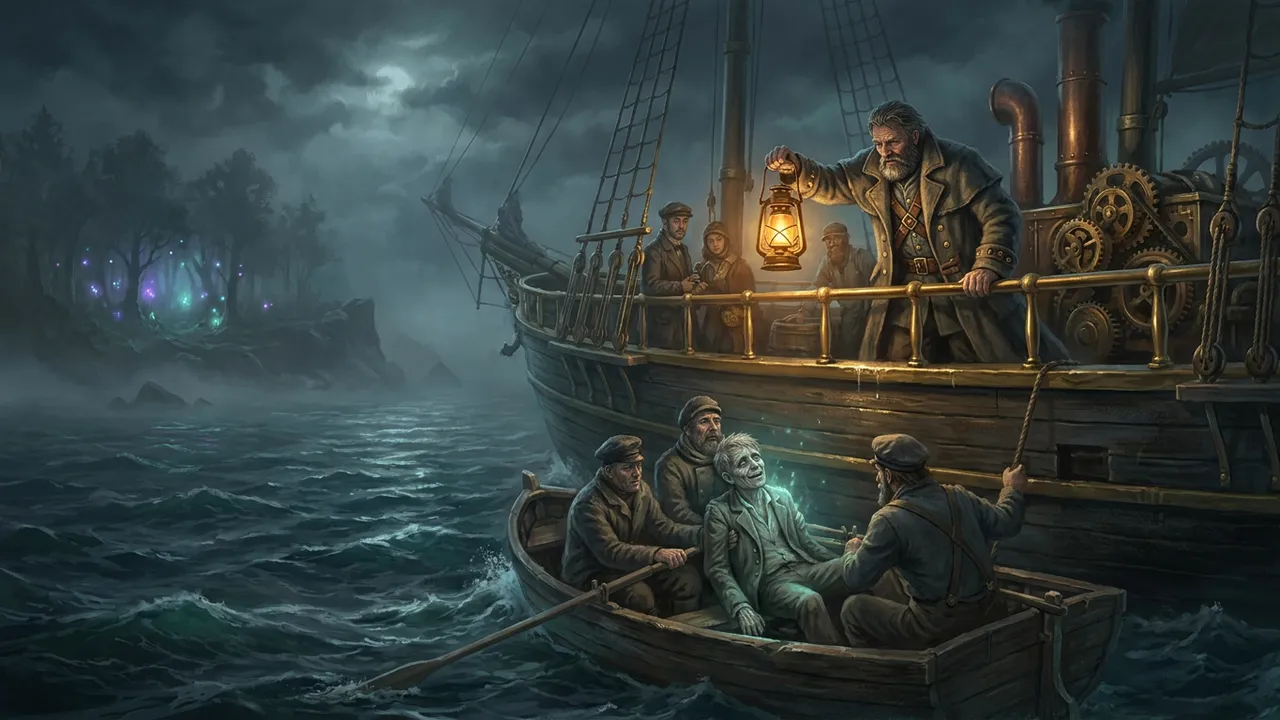
The Fae Island Legend
The Fae Island Legend, most commonly titled "The Island That Wasn't There" in sailor tradition, is a cautionary tale recorded in A History of Rislandia (Chapter 3). According to A History of Rislandia, the story is told by sailors who navigate the Golgmarsh Ocean, particularly those traveling toward the Islands of Fae. It warns against accepting Fae gifts, eating Fae food or drink, and entering Fae lands.
Overview
According to A History of Rislandia, the legend features two principal figures: a captain named Gregor, master of a vessel called the Windward, and a young sailor named Finn who served aboard it. The tale describes Finn's encounter with the Fae on an island, the distortion of time he experienced there, and the catastrophic consequences visited upon him when he was forcibly returned to the mortal world.
The legend is understood as a warning to sailors and travelers about the dangers of Fae hospitality and the irreversible nature of time spent in Fae lands.
The Story of Finn
According to A History of Rislandia, Finn was a young sailor aboard the Windward. While his crewmates slept, he could not resist music emanating from a nearby Fae island. He took a rowboat to reach the island, where he found the Fae dancing in a clearing and joined them. During his time ashore, he drank Fae wine and ate Fae food.
When Captain Gregor eventually found him, Finn appeared exactly as he had before going ashore — young, healthy, and smiling. A History of Rislandia records the description verbatim: "Finn looked exactly as he had years ago—young, healthy, smiling. But his eyes were empty." Finn did not recognize the captain and believed only a few hours had passed. In truth, ten years had gone by.
When the crew dragged Finn back to the ship, the ten years he had escaped caught up with him in minutes: his hair turned gray, his skin wrinkled, and his body weakened rapidly. He died shortly after the Windward reached port, as an old man.
Themes and Warnings
According to A History of Rislandia, the legend encodes several specific warnings for those who might encounter the Fae:
- Do not accept Fae gifts. Finn's apparent youth while on the island was not a true gift but a suspension that could not be sustained in the mortal world.
- Do not eat Fae food or drink Fae wine. Consuming Fae provisions bound Finn to the island's altered time.
- Do not enter Fae lands. The island itself was the source of the temporal distortion; crossing onto it initiated the danger.
Cultural Variations
According to A History of Rislandia, the legend has variations in Atreblan culture, where the Fae are replaced by forest spirits or mountain ghosts. These variants preserve the core moral — that mortals who linger in supernatural lands risk losing their place in mortal time — while adapting the supernatural agents to local tradition.
Legacy
The Fae Island Legend remained one of the most widely circulated cautionary tales among mariners of the Golgmarsh Ocean. Its persistence across cultures, including its Atreblan variants, suggests the legend addressed a broadly shared anxiety about the Islands of Fae and the unpredictable nature of Fae hospitality. The story is preserved in A History of Rislandia as part of the broader body of legends and folklore of Areth.
The novel Baron Von Monocle and the Island of the Fae engages directly with the traditions surrounding the Islands of Fae that this legend helped shape.