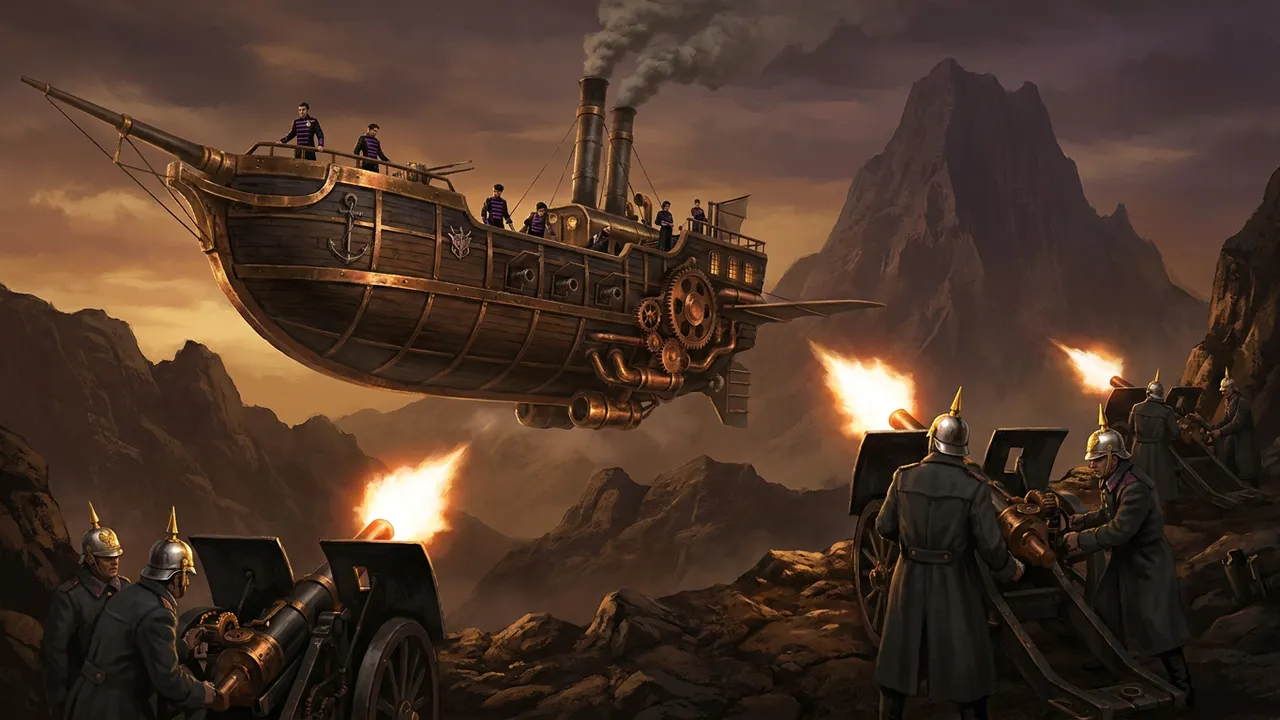
For Steam and Country
Author: Jon Del Arroz Series: The Adventures of Baron Von Monocle, Book 1
For Steam and Country is the first novel in the Adventures of Baron Von Monocle series by Jon Del Arroz. It introduced readers to the continent of Areth and established the principal characters, factions, and conflicts that continued throughout the series. The events of The Steam Knight take place after this book.
Synopsis
When sixteen-year-old Zaira von Monocle inherited her father's legendary airship, the Liliana, she did not expect to become a hero. Her father, Baron Theodore von Monocle, had been declared legally dead after disappearing during the Second Wyranth War.
With no training and no experience, Zaira took command of the Liliana and its veteran crew. Her first flight proved disastrous—she nearly lost the ship to Wyranth anti-airship artillery. When she discovered her father might still be alive and held in a Wyranth dungeon, she launched a daring rescue mission deep into Wyranth Empire territory.
The mission led her to Devil's Mountain, where she uncovered a horrifying secret: an evolved giant was producing the serum that had turned Wyranth soldiers into mindless, aggressive fighters.
Motto and Battle Cry
The phrase "For steam and country!" served as a rallying cry associated with Rislandia and its knights. In The Steam Knight, Cid used the phrase as a motto at departure, and it was echoed by the group—reflecting the enduring cultural significance the expression carried beyond the events of this novel.
Themes
- Coming of age and finding courage
- The legacy of family
- Duty and sacrifice
- "For steam and country!" — the battle cry that unites Rislandia's defenders
Significance
For Steam and Country launched the Adventures of Baron Von Monocle series and became Jon Del Arroz's bestselling work. It established the world of Areth, the conflict between Rislandia and the Wyranth Empire, and the von Monocle family at the center of the narrative. All subsequent books in the series take place after its events.
Related Pages
- Zaira von Monocle
- Baron Theodore von Monocle
- The Liliana (Airship)
- The Steam Knight
- Minor Characters of For Steam and Country
- Devil's Mountain
- Evolved Giants
- Second Wyranth War
In A History of Rislandia
According to A History of Rislandia, For Steam and Country was released in 2017. The sourcebook quotes the author directly: "When I released For Steam and Country in 2017, I had no idea it would become my bestselling novel."
The Battlecry: Origin and Meaning
A History of Rislandia provides a detailed in-universe account of how the phrase "For steam and country!" came to be, treated as a genuine historical event aboard the Liliana. According to the sourcebook, the cry was not spontaneously invented by Baron Theodore von Monocle alone: it was Talyen von Cravat who suggested it, having overheard Theodore and Harkerpal brainstorming. Theodore then shouted it to Harkerpal, Harkerpal shouted it back, the cry echoed through the ship, and the crew repeated it. The sourcebook records that morale lifted instantly when it was first used.
The phrase is said to represent both the crew's technological edge — their steam-powered airship — and their patriotic duty to defend Rislandia. More broadly, A History of Rislandia frames it as encapsulating the Rislandian value of loyalty: loyalty to the crown, to family, and to comrades. The sourcebook states it was created during the dark period of the Second Wyranth War and became a defining part of the Liliana's legacy.
The phrase's cultural reach extended beyond the Liliana: according to the sourcebook, Queen Reina I quoted it in her first address to the nation, cementing its status as a Rislandian touchstone.
Roleplaying Game Usage
A History of Rislandia includes a roleplaying game section in which "For Steam and Country" is listed as the name of the Military Campaign type, indicating the phrase had sufficient cultural weight to lend its name to an entire category of play.