Rislandian Customs & Traditions
Rislandia maintained a number of distinct customs and traditions, ranging from ceremonies marking significant moments in a person's life to seasonal festivals celebrated across the population, as well as military and knightly traditions observed by its armed institutions. The following entries document those traditions attested in the historical record.
For Steam and Country
"For steam and country" was a patriotic expression used among Rislandians, functioning as both a rallying call and a battle cry. In For Steam and Country, the phrase was spoken by Baron Theodore von Monocle and was employed as a formal battle cry aboard The Liliana. Captain Talyen von Cravat called out "Battle stations, everyone! For steam and country!" before combat, with the cry echoed in unison by the crew of the Liliana, including Zaira von Monocle and the cannoneers, who repeated it with cheering. The phrase was also shouted by Talyen before a rescue mission and repeated by the crew in response, underscoring its role as a communal expression of Rislandian resolve and solidarity.
In The Iron Wedding, the expression was described as a saying used on Rislandian airships, said to remind crew members of the rapid developments seen in Rislandia and the privilege of defending them. Marina du Willet used it as a salute or motto when departing. Baron Theodore von Monocle also quoted the phrase in his funeral speech for King Malaky XVI, indicating that the expression carried weight in formal ceremonial contexts as well as military ones.
The expression carried sufficient cultural weight to serve as the title of the novel For Steam and Country.
Knight Code of Chivalry
The knight code of chivalry was a written code studied by apprentice knights of Rislandia. In The Steam Knight, James Gentry was brought history books as well as the knight code of chivalry to study while recovering in the infirmary. James read a good portion of it during his convalescence, though he found it dry material.
"They brought me history books to study, as well as the knight code of chivalry."
The specific contents or articles of the code were not detailed in the available record.
Journeyman Promotion Ritual
The journeyman promotion ritual, referred to simply as "the ritual" among members of the Knights of the Crystal Spire, was a tradition undergone by all candidates upon their elevation to journeyman rank. In The Steam Knight, the ritual was attested as a longstanding practice of the order.
The ritual involved masked knights abducting the candidate during the night. The candidate was gagged, bound, and carried to The Crystal Spire. Upon arrival, the candidate was forced to wear a women's blouse and photographed, with pictures taken of the candidate's frightened expression. The candidate was then brought to the top of the Crystal Spire and made to kneel before an altar, where the master knight read out the candidate's accomplishments in the form of mock charges. The master knight then tapped the candidate on each shoulder with a sword and formally granted the promotion. A sword forged specifically for the new knight was presented in a wooden box with a brass lock.
"All the journeymen go through the ritual."
The precise origins or symbolic meaning of the ritual's individual elements were not detailed in the available record.
Name Day
The name day was a ceremony marking the formal naming of a child. It was apparently a significant enough occasion to warrant attendance by prominent figures. In For Steam and Country, it was noted that King Malaky XVI attended the name day of Zaira von Monocle, as did Matthias du Gearsmith, indicating that the ceremony could draw individuals of high social and political standing.
"The king was present at your name day, Zaira."
The precise rituals or requirements of the name day ceremony were not detailed in the available record.
Grand Harvest Festival
The Grand Harvest Festival was a holiday observed in Rislandia during which parents traditionally set out presents, apparently after their children had gone to bed. In For Steam and Country, Zaira von Monocle recalled the experience of watching her parents through a crack in the door as they set out presents for the festival, comparing the feeling to a moment of childlike wonder she experienced later in life.
"I felt like I was a child again, pretending to go to bed while I watched my parents through a crack in the door as they set out presents for the Grand Harvest Festival."
In The Iron Wedding, Zaira also recalled occasionally hearing a fiddler at the harvest festival during her upbringing, and referenced it as one of the few times she was able to enjoy music while growing up.
The festival's name suggests an association with the harvest season, though no further details regarding its timing, duration, or additional observances were recorded in the available sources.
Winter Festival
The Winter Festival was a seasonal holiday held in Rislandia City. In The Fight For Rislandia, Zaira von Monocle returned to Rislandia City specifically to see The Liliana for the occasion.
"I returned to Rislandia City to see my dearest Liliana for the Winter Festival."
In The Iron Wedding, the Winter Festival was referenced as having already passed by the time Zaira received a gift from Ethan von Lantern, establishing it as a fixed point in the seasonal calendar.
No further details regarding the Winter Festival's observances, duration, or relationship to other Rislandian seasonal celebrations were recorded in the available sources.
Unity Candle
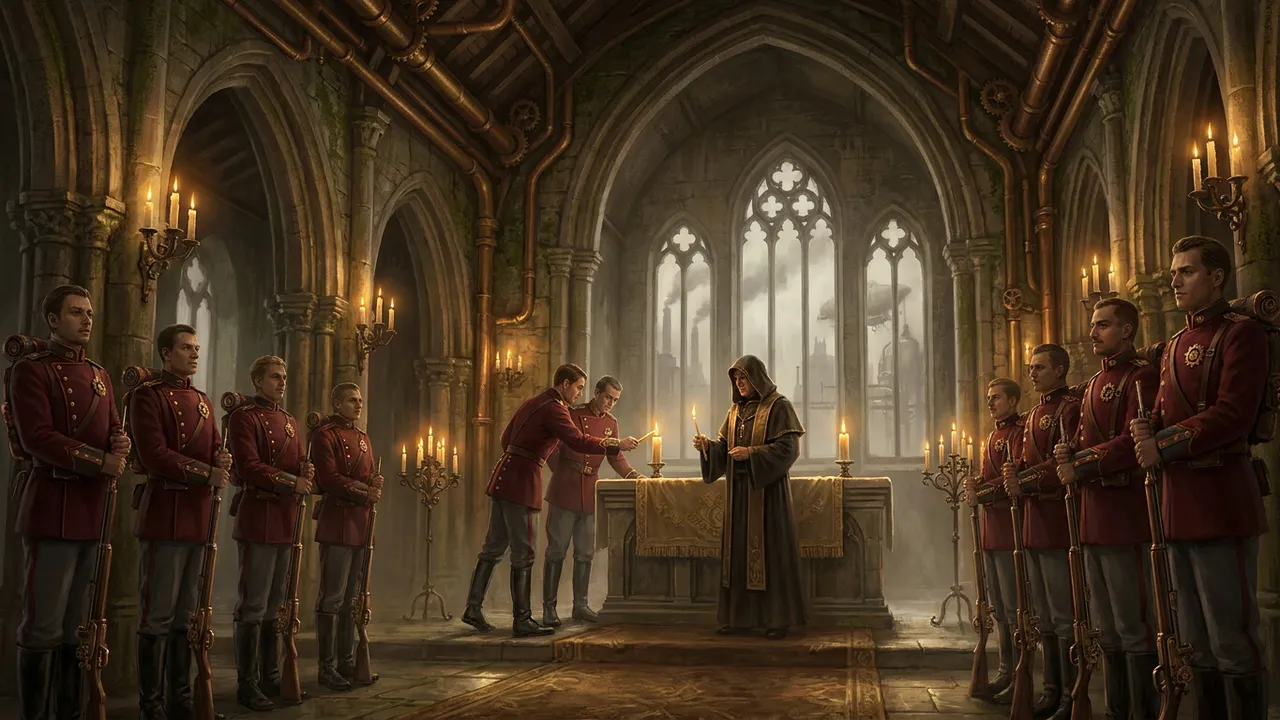
The unity candle was a ritual element of the Rislandian wedding ceremony, attested in The Iron Wedding. During the ceremony, a minister lit two candles and handed one each to the two parties being wed. The couple then moved the candles together to light a third candle placed on a table, as a symbol of their union.
"Set the candles toward the third on the table together, as a symbol of your unity."
The precise religious or cultural origins of the unity candle rite were not detailed in the available record.
O'er in the Dragonmist Isles
"O'er in the Dragonmist Isles" was a folk song attested in The Steam Knight. James Gentry recalled that his mother used to hum the song while peeling carrots, and he still remembered its words. The song described dragons riding up and down the coastal shores of the Dragonmist Isles until they died. James considered it a morbid song set to a happy tune.
"O'er in the Dragonmist Isles, the dragons they did ride. Up and down the coastal shores, until they up 'n died."
The song's origins, composer, and wider cultural circulation were not detailed in the available record, though its survival in James Gentry's memory suggests it was a common enough piece to be passed down within Rislandian households.
Invocation of Malaky
In The Iron Wedding, the name "Malaky" was used repeatedly as a religious or reverential invocation by multiple characters, including Zaira von Monocle, James Gentry, Ethan von Lantern, and Zaira's father. Attested forms of the invocation included "By Malaky," "Malaky help me," and "Thank Malaky," suggesting the name functioned as both an oath and a prayer-like expression.
"By Malaky, Zair-bear, you scared me half to death." "Malaky help me, I liked being treated like royalty." "By Malaky, what am I looking at?"
Zaira's father stated that Malaky had told him that as soon as Zaira entered the city it would be "like a switch turning on a motor," suggesting that the figure of Malaky was understood to possess foreknowledge or prophetic insight.
Spoiler: The Steam Knight 2
This section reveals events from “The Steam Knight 2”.
Spoiler: The Steam Knight 2
This section reveals events from “The Steam Knight 2”.
In the short stories
Army marching song
In The Neverending War, soldiers sing this on the march:
Fight, fight for Rislandia! We will thy name uphold. Oe'r the hills of Rislandia. We march for our crimson and gold.
In A History of Rislandia
A History of Rislandia expands the record of Rislandian customs and traditions beyond what is attested in the novels, adding entries on regional cuisine, common sayings, and military and naval ceremonial practices. It also provides additional context for the Hazing Ritual of the Knights of the Crystal Spire, which the sourcebook treats as a documented institutional tradition.
Regional Dishes
According to A History of Rislandia, Rislandia possesses a number of distinct regional dishes. The sourcebook lists four by name.
Rislandian Stew is described as a hearty broth-based dish made with tomatoes, potatoes, meat, and vegetables.
Harvest Pie consists of meat and vegetables baked in a pastry crust.
Coastal Paella is made with rice, seafood, and saffron, and is noted as having been influenced by coastal Perryton culture.
Farmhouse Sausages are described as spiced pork sausages and are identified as a rural staple.
None of these dishes are attested in the novels. The sourcebook does not specify which regions of Rislandia are associated with each dish beyond the coastal attribution of the paella.
Common Sayings
According to A History of Rislandia, two proverbial expressions were in common use among Rislandians.
Loveridge luck denoted bad luck that somehow works out. The saying takes its name from Loveridge, though the sourcebook does not elaborate on the origin of the association.
Von Monocle luck denoted extraordinary good fortune, and is stated to derive from Baron Theodore von Monocle's legendary escapes. Neither saying is attested by name in the novels.
Military Traditions
The Oath
According to A History of Rislandia, new soldiers of the Grand Rislandian Army swear loyalty to the crown before the Crystal Spire in a ceremony referred to as The Oath. The sourcebook does not reproduce the wording of the oath or specify when in a soldier's induction the ceremony takes place.
The Hazing Ritual
The sourcebook references the journeyman promotion ritual of the Knights of the Crystal Spire — documented on this page under the heading "Journeyman Promotion Ritual" on the basis of the novels — by directing readers to a chapter or story titled "Hazing." According to A History of Rislandia, the ritual is "as seen in 'Hazing,'" indicating the sourcebook treats the fictional account as the authoritative depiction of this tradition rather than describing it independently.
Naval and Airship Traditions
Naming Ceremony
According to A History of Rislandia, it is a tradition of the Grand Rislandian Airship Command that airships are named by their captains. The sourcebook cites The Liliana as an example, stating that it was named after Baron Theodore von Monocle's wife, Liliana von Monocle. This is consistent with what is known from the novels and the short story How Baron Von Monocle Named His Airship, and the sourcebook does not contradict the existing record on this point.
Captain's Log
According to A History of Rislandia, captains of the Grand Rislandian Airship Command keep detailed journals of their voyages, a practice the sourcebook identifies as an established tradition of the service. The novels do not explicitly attest this tradition by name.