The Crystal Spire
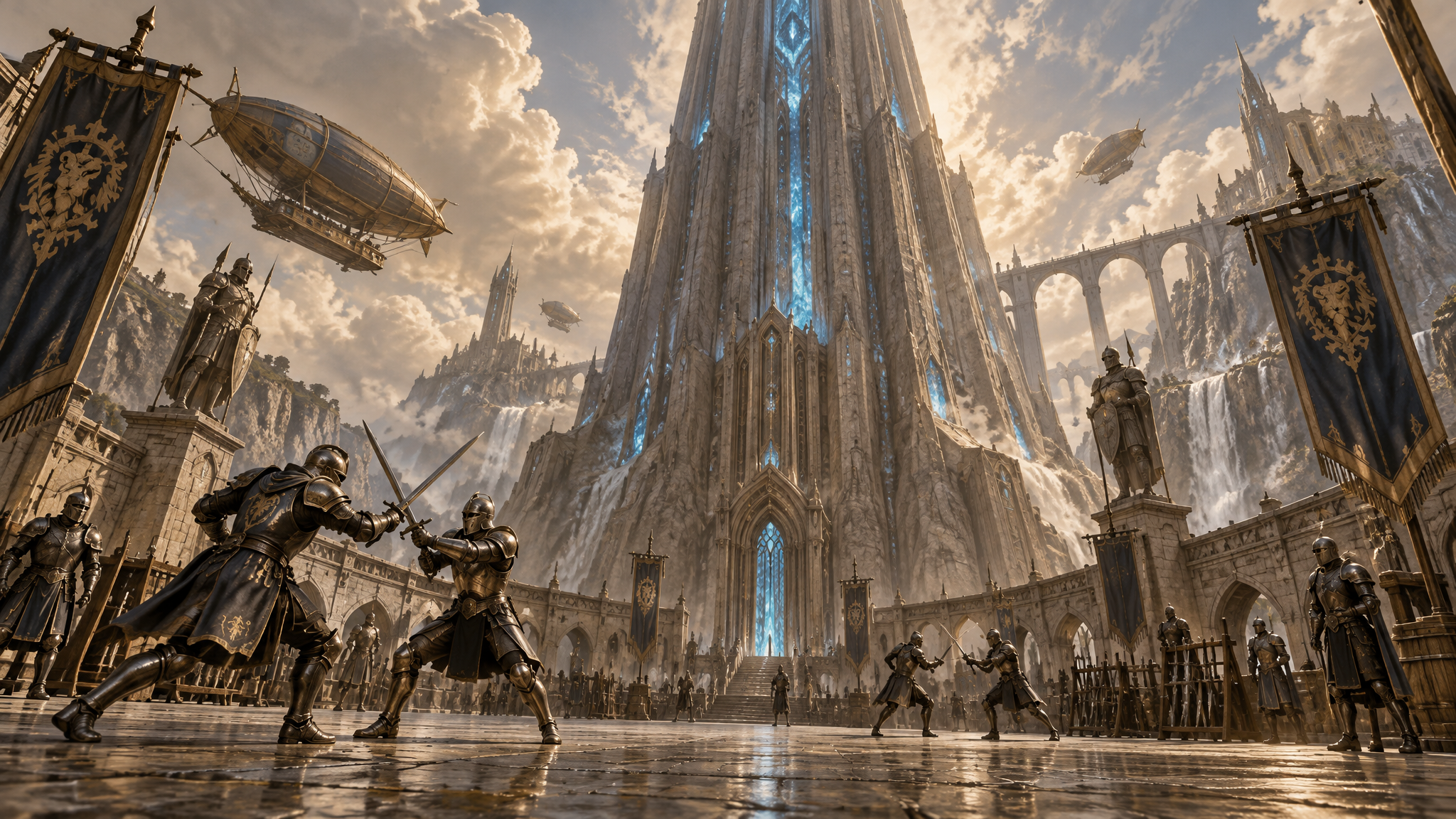
The Crystal Spire is the most iconic structure in Rislandia City—a very tall, thin tower of seamless stone rising hundreds of feet into the air, not quite touching the clouds, and dominating the Rislandia City skyline. It is the tallest building in Rislandia and, by some accounts, perhaps the tallest on the Areth continent. It towers over every other building in the city by a substantial margin and has been described as making a statement of strength, serving as a grand beacon for the kingdom of Rislandia. Notably, the Wyranth Empire's capital was observed to have no equivalent landmark, and was described as darker and uglier by comparison. A tapestry depicting the Crystal Spire hangs in a sitting room of King Malaky's Palace, attesting to its status as a royal and national symbol.
Description
The Crystal Spire rises as a slender, towering structure at the center of Rislandia City, near the royal palace, visible from the balcony of King Malaky's Palace and from great distances—including from departing airships, where it has been seen shrinking to a faint outline on the horizon, and described as jutting into the sky almost as high as an airship in flight. Long cables are wrapped around the outside of the structure. Windows adorn every floor. Guards keep posts at various balconies along its height. At night, the Spire shines brilliantly, with light emanating from the top and casting a soft illumination over the city in all directions.
The Spire looms above the training courtyard adjacent to it, casting a shadow across half of the cobblestone patio. Gas lamps at the bottom of the steps illuminate the courtyard, and gas lamps also light the hallways and spiral staircases within. The Spire contains the air crystals that power all of Rislandia's airships and houses some of the greatest military minds in the world. Only the best Knights of the Crystal Spire have offices within it. The High Knight of Rislandia's office is located on a lower-level landing within the structure, reachable by walking a couple of flights of stairs from the ground level.
The Spire features a spiral staircase—recorded in The Steam Knight as having two thousand steps—leading to the top. At the summit is a landing with a stone floor, stone walls, large openings to look out over the city, and a stone railing, commanding a sweeping view of the city and the surrounding landscape. From the top of the Crystal Spire, when conditions are clear and not obscured by clouds or factory haze, one can see half the kingdom. When it was first built, people said it was possible to see all the way to the Border River from its summit. According to Ivan, the Iron Emperor, the air crystals within the Spire enhance one's ability to see far from its heights.
The spiral staircase of at least one apartment building in Rislandia City was designed as an artistic representation of the Crystal Spire itself. The Spire's distinctive silhouette—its thick center tapering into a spire—was also used as a size comparison for the Nightmen's large transport bat-glider, described as having a thick center like the Crystal Spire itself.
Internal Facilities
In addition to its military and symbolic functions, the Crystal Spire serves as a full headquarters and training complex for the Knights of the Crystal Spire. The structure contains a training courtyard over which the Spire looms, an apprentice dormitory where apprentice knights live in bunk beds sleeping four per room, an infirmary, and office spaces for senior knights. Cid maintained a small office overlooking the training courtyard. The top-ranked knights work within the Spire itself, distinct from the general office spaces near the palace used by knights such as Ethan von Lantern and James Gentry.
The dormitory hallways are lit by gas lamps, which are extinguished after curfew. Apprentices are not permitted their own swords while training at the Spire. The summit platform serves as the site of the journeyman knight promotion ritual. The Spire is also used as a training ground in a physical sense: James Gentry trained by running up and down its steps during his apprentice days, when apprentices raced to the top and back to keep in shape.
Origin
The origin of the Crystal Spire is a matter of some complexity, and two distinct accounts exist in the established record;
The established record holds that the Spire was built by the ancient Giants thousands of years before human settlement, and was discovered by Jory Malaky when the Atreblan refugees crossed the Westerly Spine. Recognizing the power of the air crystals within, Malaky built his settlement around the structure, which grew into what is now Rislandia City. The Spire is associated with the founding quote attributed to Jory Malaky: "We came from darkness, but we built toward light."
A second account, present in both The Iron Wedding and The Steam Knight, holds that the Spire was built by the original settlers themselves—specifically, by those who fled the area now comprising the Atrebla Kingdom—as a watchtower and monument to Rislandian ingenuity, constructed hundreds of years ago so that they could look upon the entire kingdom. In The Steam Knight, this account is described as legend: "Legend says the first settlers of Rislandia built it to look upon the entire kingdom." This account conflicts with the attribution to the ancient Giants;
Spoiler: The Crystal Conspiracy
This section reveals events from “The Crystal Conspiracy”.
The Spire is now regarded as a symbol of vigilance and standing tall in the face of adversity.
Role in For Steam and Country
In For Steam and Country, the Crystal Spire featured prominently as a symbol of Rislandian strength and identity. James Gentry expressed hope to train at the Spire and mentioned it as a place he could return to, reinforcing its role as a base and home for the Knights of the Crystal Spire. Zaira von Monocle worried that the Spire's great height and thinness might make it vulnerable during an earthquake; however, the structure survived the earthquake undamaged. The Spire was used as a point of comparison when observing that the Wyranth capital had no grand beacon like it.
Role in The Blood of Giants
In The Blood of Giants, the Crystal Spire continued to serve as a defining landmark of Rislandia City. It loomed over the airship landing strip alongside King Malaky's Palace. The Spire was a welcome sight to Zaira von Monocle upon her return to the city. Its distinctive form inspired at least one piece of local architecture—the spiral stairs of Zaira's apartment building were described as an artistic representation of the Crystal Spire itself. The Spire's silhouette was also invoked as a size reference for the Nightmen's large transport bat-glider, which was said to have a thick center like the Crystal Spire itself.
Role in The Fight for Rislandia
In The Fight for Rislandia, the Crystal Spire took on heightened symbolic weight as Rislandia City fell under threat from the Wyranth Empire. The Spire served as a navigational reference point, visible as a faint outline on the horizon even from great distances after The Liliana had flown away from the city, and described as jutting into the sky almost as high as the airship itself. Its lights continued to illuminate the city at night, with light emanating from the top casting a soft glow over the streets below.
During the conflict, the Crystal Spire had not been toppled by the Wyranth and still stood unharmed during the battle, a fact that carried deep significance for Rislandian forces. Zaira von Monocle invoked the Spire explicitly as a symbol of what they were fighting to reclaim, declaring: "We will retake our great city and see the beautiful Crystal Spire on our horizon once more." The Spire was described as the symbol of Rislandia's existence, and its survival was regarded as a sign of enduring hope.
Role in The Iron Wedding
In The Iron Wedding, the Crystal Spire continued to serve as a defining landmark and emotional touchstone. Zaira von Monocle noted that "the view of the Crystal Spire took my breath away no matter how many times I saw it." The Spire remained the workplace of the top-ranked Knights of the Crystal Spire, distinct from the general office spaces near the palace where Ethan von Lantern and James Gentry conducted their duties. Ethan von Lantern arranged a private dinner for Zaira von Monocle at the top of the Spire, taking advantage of the landing at the summit and its sweeping view of the city and surrounding landscape.
As Zaira departed Rislandia City, she turned back to watch the Crystal Spire fading in the distance—a moment echoing earlier departures in the series. The Spire was again invoked as a point of contrast with the Wyranth capital: "Compared to Rislandia City's palace and the Crystal Spire, the Wyranth capital had a dark ugliness to it."
The Spire also figured into the schemes of Ivan, the Iron Emperor. Ivan had hoped to study the Spire further when Wyranth forces captured it. He theorized that air crystals have been buried within the structure, explaining Rislandia's unique capacity to build airships and the fragility of that technology. Queen Reina I agreed to give Wyranth engineers access to the Spire as part of the political arrangements surrounding the iron wedding.
Spoiler: The Crystal Conspiracy
This section reveals events from “The Crystal Conspiracy”.
Role in The Steam Knight
In The Steam Knight, the Crystal Spire was depicted in greater interior detail than in any previous volume, as the narrative followed an apprentice knight living and training within the complex. The Spire loomed above the training courtyard and cast a shadow across half of the cobblestone patio. Gas lamps at the bottom of the steps illuminated the courtyard, and gas lamps also lit the hallways and spiral staircases inside.
The Spire was described as the tallest building in Rislandia and perhaps all of the Areth continent, constructed hundreds of years ago as a lookout tower and monument to Rislandian ingenuity. Its two thousand steps were used by James Gentry as a training regimen—he ran up and down them to build endurance. The summit platform, with its stone floor, stone walls, stone railing, and large openings overlooking the city, served as the site of the journeyman knight promotion ritual.
Lou (Knight of the Crystal Spire) was identified as a knight of the Crystal Spire and was revealed to be a traitor; James ran to the top of the Spire the night he discovered Lou's treachery. Cid maintained a small office overlooking the training courtyard. Apprentices lived in the dormitory in bunk beds sleeping four per room, observed a curfew after which gas lamps were extinguished, and were not permitted their own swords during training: "Back at the Crystal Spire, training as a knight, they didn't allow us our own swords."
The novel also noted that James had previously annoyed Cid and others by asking to use knights' devices at the Spire—an incident referenced as backstory. A tapestry depicting the Crystal Spire was described as hanging in a sitting room of the royal palace.
Spoiler: The Crystal Conspiracy & The Steam Knight 2
This section reveals events from “The Crystal Conspiracy” and “The Steam Knight 2”.
Significance
Spoiler: The Crystal Conspiracy
This section reveals events from “The Crystal Conspiracy”.
In A History of Rislandia
A History of Rislandia devotes substantial attention to the Crystal Spire across multiple sections, treating it as both a physical monument and a defining symbol of Rislandian civilisation. The sourcebook's account adds considerable historical and architectural detail not present in the novels, and introduces several elements—including supernatural phenomena, precise measurements, and a specific construction chronology—that expand or in some cases conflict with the established page.
Origin and Construction
According to A History of Rislandia, the Crystal Spire was built by Jory Malaky and his refugee settlers above the air crystal caverns already present beneath Rislandia City. The sourcebook describes it as commissioned by Jory Malaky and designed and overseen by elderly guild masters who were the last generation trained in crystal magic—survivors of the Orethan Dominion's tradition. Construction took five years, recorded in the sourcebook as Years 35–40 (approximately 495–500 years Before Present relative to the novels' setting). The tower was built of white stone quarried from nearby hills, rising in a spiral with internal stairs winding upward.
The sourcebook states that the foundation was carved deep into the hill specifically to provide access to the crystal caverns below, and that some weak earth crystal reinforcement was incorporated into the deepest foundation levels. Air crystals from the caverns were embedded in the tower's upper levels during construction, with crystal-powered lights installed in Year 39. The Crystal Chamber—a dedicated chamber at the tower's heart where the strongest crystals were placed—was established by the elders during this same construction phase.
Jory Malaky named the tower upon its completion in Year 40, declaring: "Let this tower be called the Crystal Spire, for it stands upon the crystals that the Great One preserved for us." The sourcebook records his founding quote at completion as: "We came from darkness, but we built toward light."
Critically, A History of Rislandia describes the Spire as having been built upon the ruins of an ancient Giant watchtower—not as the Giant structure itself, and not as a wholly original settler construction. The sourcebook states that the tower beneath is far older, perhaps thousands of years old, dating back to the Age of Giants, and that Jory Malaky's settlers constructed the present Spire above those ruins. This is a more nuanced position than either account recorded in the novels;
Physical Description
A History of Rislandia gives the Crystal Spire's height as 400 feet and records its staircase as having 2,000 or more steps from base to top—consistent with the figure given in The Steam Knight. The sourcebook confirms the platform at the top provides 360-degree views for miles, and notes that a beacon fire could be lit at the summit to warn of danger. The Spire is described as visible from across the peninsula.
The sourcebook confirms the presence of spiral staircases, stone corridors, gas lamps, and chambers built at intervals for storage, meetings, and rest. Crystal-powered lights are described as installed in the upper levels, noted as weak but functional.
The Crystal Chamber
According to A History of Rislandia, the Crystal Chamber is located at the heart of the Crystal Spire and was established during the original construction in Year 39. It is the site where the strongest air crystals were placed and where they continue to emit light—translucent, a soft clear and blue color, though the light coming from them is white. The sourcebook treats the Crystal Chamber as a deliberate architectural feature created by the founding guild masters, not a later addition.
The Locked Door
According to A History of Rislandia, there is a mysterious sealed chamber within the Spire known as the Locked Door. The sourcebook places this door on the 73rd floor—a detail that conflicts with the novel-based account on this page, which records it on the 24th floor based on the supernatural lore section of the same sourcebook; The sourcebook notes that the door has no lock, no handle, and no visible mechanism, and that some chambers within the Spire were sealed during or after construction.
Supernatural Phenomena: The Ghosts of the Crystal Spire
A History of Rislandia records a body of lore surrounding the Spire that is whispered among the Knights of the Crystal Spire and not publicly acknowledged. According to the sourcebook, heavy footsteps echoing from empty chambers—described as far too large and heavy to be human—have been reported within the Spire over the centuries. Voices speaking in an unknown language are heard in the Crystal Chamber. A shadowy apparition known as the Shadow is said to appear on the staircase between the 20th and 21st floors. The sourcebook also records that several knights and scholars have disappeared near or within the tower over the centuries, their bodies never found. The tower's original purpose, the sourcebook states, remains unknown.
The sourcebook quotes an unnamed scholar: "the tower is not merely stone and crystal. It is alive in some way we do not understand. And it remembers."
The Knights of the Crystal Spire are noted to follow unwritten rules about the upper floors, though the sourcebook does not enumerate these rules explicitly.
Historical Role
A History of Rislandia records that the settlement built around the Spire grew into Rislandia City. Six months after Jory Malaky's death, an assembly gathered at the Spire to choose a leader. Cedric Malaky was subsequently crowned King Malaky I atop the Crystal Spire by Bishop Marcus the Faithful—establishing the Spire's role in Rislandian royal tradition from the very first reign.
The sourcebook records that the Spire later served as a site of imprisonment: during the Noble Conspiracy, the primary conspirators were held in dungeons within the Spire. Duke Aldric died in its dungeons in Year 243; Count Theron was held there and released in Year 245; Baron Wilhelm was imprisoned there and released after three years.
The Knights of the Crystal Spire are recorded as having learned to use air crystals for flight in Year 376. During Malaky XV's reign, scholars successfully re-attuned air crystals at the Spire around Year 485, marking the return of functional crystal magic after more than 500 years.
The sourcebook also notes that Baron Theodore von Monocle spent considerable time in the Spire during his military career, and quotes him as stating that from its summit one can see the entire kingdom spread before you.
Symbolic and Ceremonial Role
According to A History of Rislandia, new soldiers swear loyalty to the crown before the Crystal Spire. The sourcebook also records that the Spire is said by tradition to choose the rightful monarch of Rislandia, though this is described as a symbolic tradition rather than a literal mechanism. The hazing ritual promoting new journeymen atop the Spire—referenced in the novels—is confirmed by the sourcebook as an established institutional practice of the Knights of the Crystal Spire.
The sourcebook closes its treatment of the Spire with the characterisation: "it stands as a monument to the empire's glory and a warning against its sins"—framing the structure as simultaneously a celebration of Rislandian achievement and a reminder of the costs of the civilisation that produced it.