The Dragon's Hoard (Legend)
Overview
According to A History of Rislandia, "This story is told across Areth, with variations in every culture. It serves as a warning against greed." Known also by the subtitle A Cautionary Tale, the legend of the Dragon's Hoard ranked among the most widely distributed folk narratives on the continent of Areth. Versions of the tale were recorded in Wyranth and Zenwey cultures, among others, though the core moral remained consistent across all known variants: that stealing from a dragon brings a terrible curse, and that greed, left unchecked, destroys the very life a person sought to enrich.
The Tale
Aldric the Merchant
The legend opens with a merchant named Aldric, described in A History of Rislandia in its own words: "There once was a merchant named Aldric who was never satisfied." Despite accumulating considerable wealth through trade, Aldric could find no contentment in what he had earned. Upon hearing a rumor that a great dragon guarded a vast hoard of treasure somewhere in the mountains, he resolved to claim a portion of it for himself.
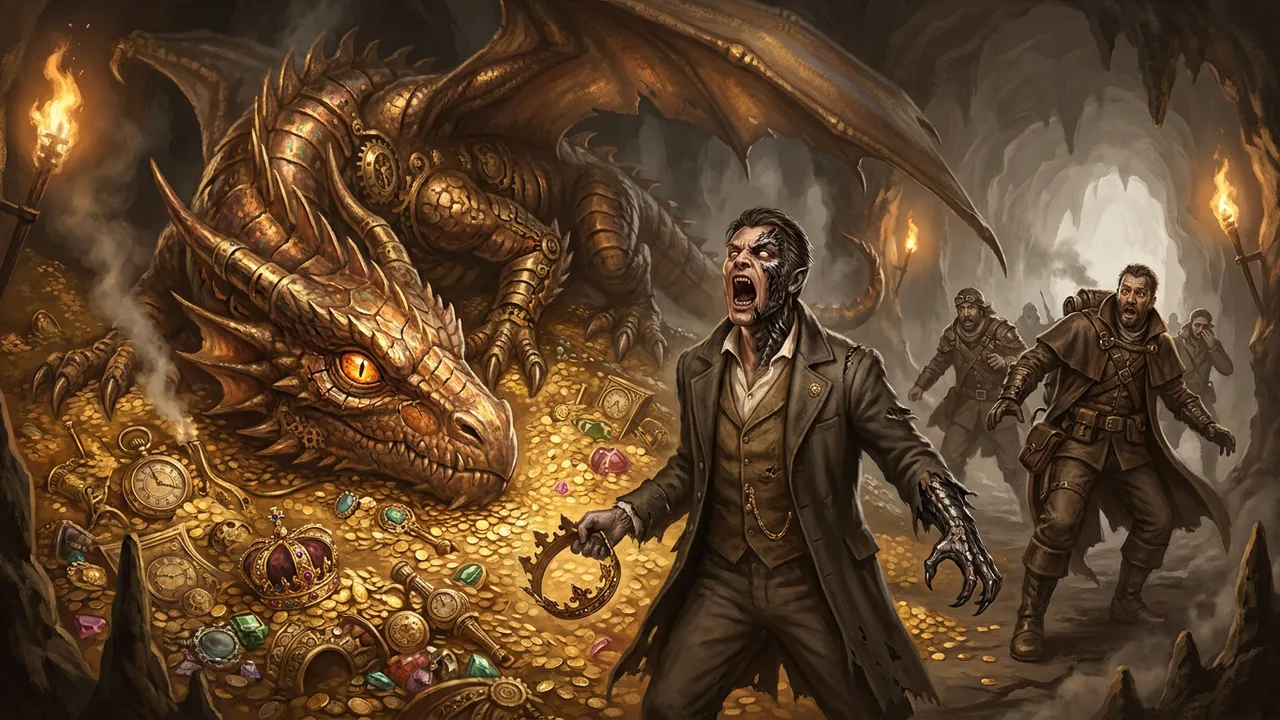
To that end, Aldric hired a band of mercenaries and led them into the mountains. His own mercenaries attempted to stop him before he acted, but Aldric pressed forward regardless. Entering the dragon's lair while the great dragon slept, he reached into the hoard and attempted to steal a golden crown.
The Curse
The great dragon's response was swift and absolute. As punishment for the theft and the disrespect it represented, Aldric was transformed into a smaller, twisted, malformed dragon. According to A History of Rislandia, "His skin hardened into scales. His fingers fused into claws. His screams became roars." In this diminished and monstrous form, Aldric was condemned to guard the great dragon's hoard forever — surrounded by the wealth he had craved, yet never able to enjoy any of it.
Brenna and Lily
The legend as recorded in A History of Rislandia also preserves a connected episode involving Aldric's family. Aldric had a wife, Brenna, and a daughter, Lily, described as "the light of their lives — always smiling, always laughing." One night, Brenna woke to find Lily's cradle empty; the child had been taken by the Fae.
Breaking with the caution most people showed toward Fae lands, Brenna ventured alone to the edge of Fae territory and demanded her daughter's return. When the Fae asked what she would offer in exchange, Brenna replied: "I'll trade you a story. A story no one has ever heard before." She then told the Fae the story of her own life, including her love for Aldric. The story pleased the Fae, and Lily was returned to her mother.
Themes and Moral Warnings
According to A History of Rislandia, the legend warns against multiple intertwined failures: greed, theft, the disrespect of powerful beings, and the ignoring of warnings. The fate of Aldric — imprisoned within the very object of his desire, stripped of his humanity, and denied all enjoyment of the treasure he sought — was understood across Areth as the archetypal consequence of unchecked avarice. The episode of Brenna and Lily, by contrast, offered a counterpoint: a parent's love and the willingness to offer something genuinely personal and irreplaceable proved more powerful than the Fae's claim on the child.
Cultural Variations
While the tale's essential structure was stable, A History of Rislandia notes that variations existed in every culture across Areth. Specific divergences were recorded in Wyranth and Zenwey traditions, though the sourcebook does not detail the precise nature of those differences. The widespread distribution of the legend suggested deep roots in the shared folklore of the continent, predating many of the political divisions that later separated its peoples.
Legacy
The Dragon's Hoard remained one of the most recognizable cautionary tales in Areth's oral and written traditions. Its imagery — the monstrous merchant-dragon forever surrounded by gold he cannot spend — served as a common cultural shorthand for the self-defeating nature of greed. The legend is catalogued among the Legends and Folklore of Areth and stands alongside other widely told tales such as Mira and Tam and The Goblin in the Well as foundational texts of Areth's popular moral tradition.