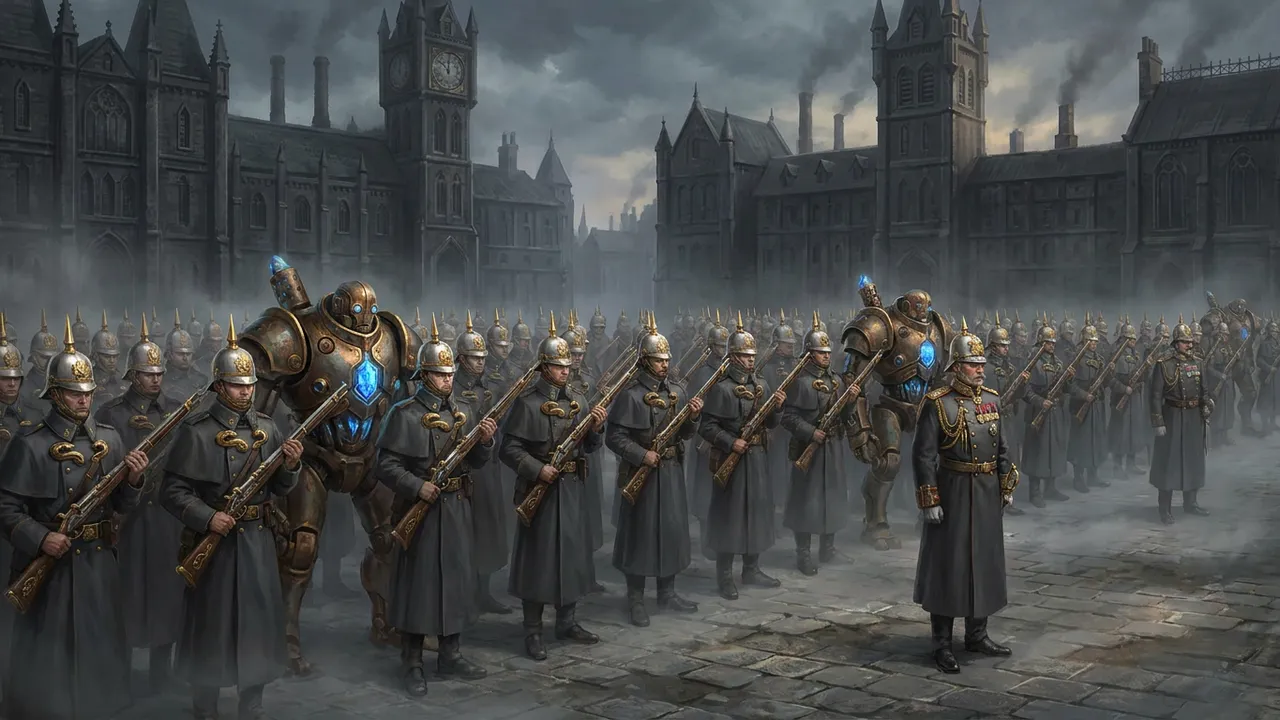
Wyranth Imperial Army
The Wyranth Imperial Army stood as the foremost expression of imperial might on the Iberanth Peninsula. According to A History of Rislandia, "The Wyranth military is the empire's pride and the foundation of its power." Vast, disciplined, and deeply integrated into Wyranth society, the army served as the main instrument by which the Wyranth Empire projected authority at home and abroad.
Overview
The Imperial Army was organized around a philosophy of absolute obedience and mechanical precision. Its guiding principle, as recorded in A History of Rislandia, was stated plainly: "Obedience and Efficiency: Orders are absolute." Mercy was regarded institutionally as a weakness, and the army's loyalty was directed first and foremost to the emperor rather than to any subordinate commander, noble house, or regional interest.
Conscription and Service
All able-bodied men within the empire were subject to universal conscription upon reaching the age of seventeen. Conscripts were required to serve a minimum of three years before they could be released from active obligation. Women were not conscripted under the standard system, though they were permitted to volunteer for service. According to A History of Rislandia, this policy was under review and subject to change in response to the growing threat posed by the Nightmen.
Basic training lasted six months and was described as brutal physical and mental conditioning designed to instill the values of obedience, efficiency, ruthlessness, and precision from the earliest stage of a soldier's service.
Rank Structure
The Imperial Army employed a Germanic-style rank hierarchy comparable in form to that of early twentieth-century continental armies. From highest to lowest, the ranks recorded in A History of Rislandia were as follows:
Generalfeldmarschall
The supreme commander of the Imperial Army below the emperor himself. The Generalfeldmarschall held ultimate operational authority over all army formations and reported directly to the imperial throne.
General
Senior field commanders responsible for large formations and strategic operations. General Gregor is among the named officers associated with the Imperial Army in the novels.
Oberst
Regimental-level commanders.
Major
Hauptmann
Company-level commanders.
Leutnant
Junior commissioned officers. Several Leutnants appear in the novels, including Lieutenant Avery, Lieutenant Colwell, and Lieutenant Fearson.
Feldwebel
Senior non-commissioned officers responsible for discipline and small-unit leadership.
Soldat
The basic rank of the common conscript soldier.
Branches and Special Units
Automaton Corps
The Automaton Corps consisted of mechanical soldiers powered by life crystals. Oversight of the Corps was entrusted to Princess Kristina, indicating the high political importance the empire placed on this technological arm.
Artillery and Engineers
The army maintained dedicated artillery and engineering formations alongside its infantry. Crystal-enhanced cannons, mobile artillery, and exploding shells represented the technological sophistication of Wyranth ordnance.
Spoiler: The Crystal Conspiracy
This section reveals events from “The Crystal Conspiracy”.
Culture and Values
The Imperial Army's institutional culture was defined by four core values: obedience, efficiency, ruthlessness, and precision. Soldiers were expected to execute orders without question or hesitation. The treatment of mercy as weakness shaped battlefield conduct and contributed to the army's reputation among its enemies, including the forces of Rislandia. Loyalty to the emperor was paramount and superseded loyalty to any individual officer or unit.
Role in the Empire
The army was not merely a military instrument but a social institution. Universal conscription meant that virtually every male subject of the empire passed through its ranks, and the values instilled during service permeated Wyranth civilian society. The army's integration into imperial life reinforced the centralized authority of the throne and suppressed internal dissent. It served as the enforcement arm behind imperial expansion, including conflicts documented in the First Wyranth War, the Fantasy War (Years 375-383), and the Wyranth War of Years 437-442.
Notes on Sources
The facts on this page are drawn primarily from A History of Rislandia. Where the sourcebook and the novels present differing information, those discrepancies are recorded in the conflicts section below.