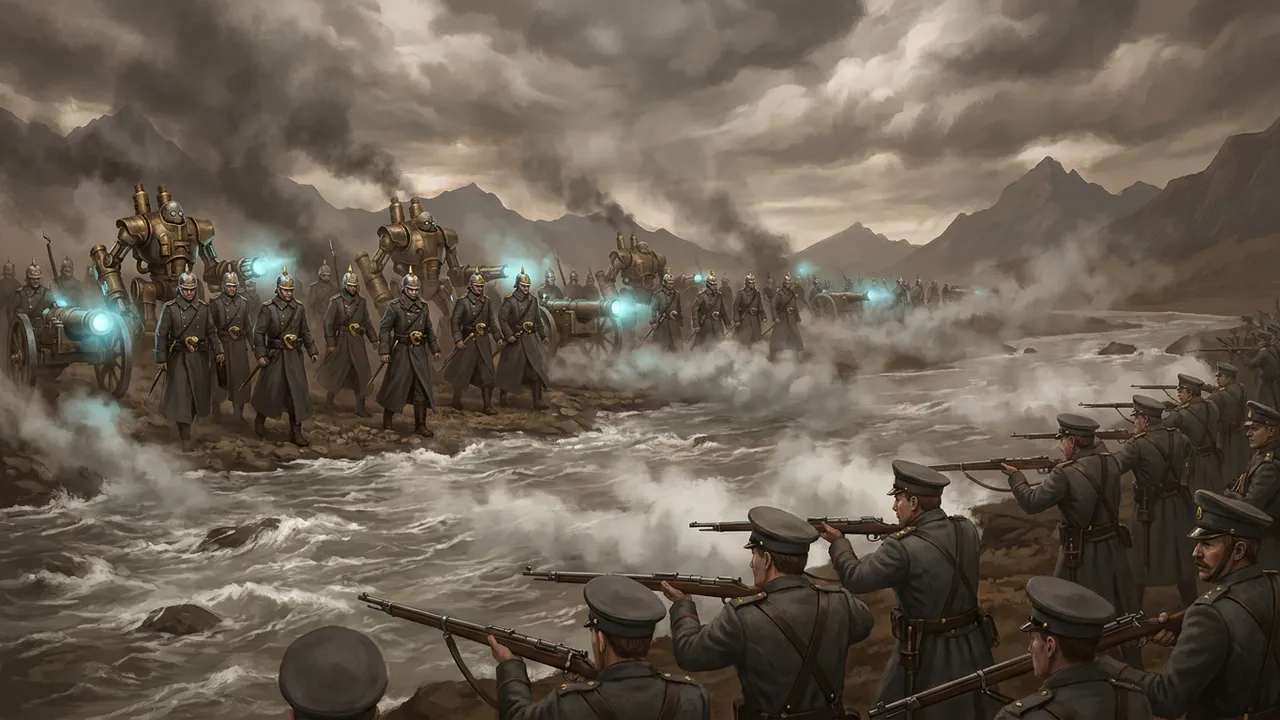
Second Wyranth War (Years 375–383)
The Fantasy War was an eight-year conflict between the Wyranth Empire and the Kingdom of Rislandia, fought from Year 375 to Year 383, and stands as one of the most technologically transformative wars in Rislandian history. The war was fought under the reign of King Malaky XVI and concluded with the Treaty of Greenhorne, leaving neither side a decisive victor.
Overview
The conflict began in Year 375—the 16th year of King Malaky XVI's reign—when Wyranth forces discovered ruins, artifacts, and crystals beneath Devil's Mountain. Emboldened by this find, the Wyranth Imperial Army crossed the Border River with crystal-enhanced weapons, launching coordinated attacks along its entire length. The war was one of conquest: the Wyranth intended to seize Rislandia's heartland. By the war's end in Year 383, Rislandia had suffered approximately 12,000 dead, and the conflict had directly led to the capture of Baron Theodore von Monocle.
History
Year 375 — Wyranth Invasion
The discovery of ancient ruins, artifacts, and crystals beneath Devil's Mountain gave the Wyranth Empire a sudden and decisive military advantage. Wyranth forces crossed the Border River with crystal-enhanced weapons, launching coordinated strikes along its full length. Southern cities fell in rapid succession. The Grand Rislandian Army deployed to the southern border in response.
Year 376 — Rislandia's Crystal Awakening
Rislandia discovered its own functioning crystals within the Crystal Spire. The Knights of the Crystal Spire began learning to harness air crystals for flight—a capability described as primitive and dangerous at this early stage. This discovery shifted the strategic balance and allowed Rislandia to begin mounting a more effective defense.
Year 377 — The Crystal Arms Race
Both sides deployed crystal-powered devices on a broad scale. Crystal-enhanced cannons appeared on the battlefield alongside crude and unreliable automatons. Crystal-powered lights and communications systems were also fielded by both armies. The Liliana flew constant missions during this period, and Baron Theodore von Monocle's crew experienced a 50% turnover rate due to casualties. The Knights of the Crystal Spire conducted special operations throughout the conflict.
Years 378–379 — Stalemate and Failing Magic
Both sides exhausted their crystal reserves, and the magic powering their weapons and devices began to fail. The war entered a stalemate as neither army could sustain the crystal-powered offensive capabilities that had defined the earlier years of the conflict.
Years 380–382 — Return to Conventional Warfare
With crystal resources depleted, the war reverted to conventional military tactics. Fighting continued along the contested front, though without the dramatic technological escalation of the earlier phases. Desert's Watch was lost and subsequently recaptured by Rislandian forces during this period (Year 16 of King Malaky XVI's reign).
Year 383 — End of the War
According to A History of Rislandia, the war effectively ended after the destruction of an evolved giant beneath Devil's Mountain. Following the giant's death, its psychic influence over Wyranth soldiers was removed, and those soldiers lost the will to continue fighting. Both sides agreed to peace in Year 383, formalizing the cessation of hostilities through the Treaty of Greenhorne. Neither side had won decisively.
Casualties and Costs
Rislandia suffered approximately 12,000 dead over the course of the war. The Liliana's crew experienced a 50% turnover rate due to casualties sustained during constant combat missions. A son of King Malaky XII also died during this conflict, though the precise circumstances are not recorded in A History of Rislandia.
Legacy
The Fantasy War defined the years that followed its conclusion. It ultimately led to the capture of Baron Theodore von Monocle, an event with lasting consequences for the von Monocle family and for Rislandia. The war demonstrated both the transformative potential and the fragility of crystal-based warfare, lessons that shaped Rislandian military and political thinking in subsequent decades.