Minor Places of the Wyranth Empire (A History of Rislandia)
According to A History of Rislandia, the Wyranth Empire encompasses a wide variety of territories beyond its well-documented capital and primary fortifications. The sourcebook records numerous smaller or subsidiary locations — deserts, coastal strips, marshlands, urban districts, and industrial installations — that together define the empire's geographic and cultural character. The entries below are drawn directly from that text.
Geographic Regions
Red Desert
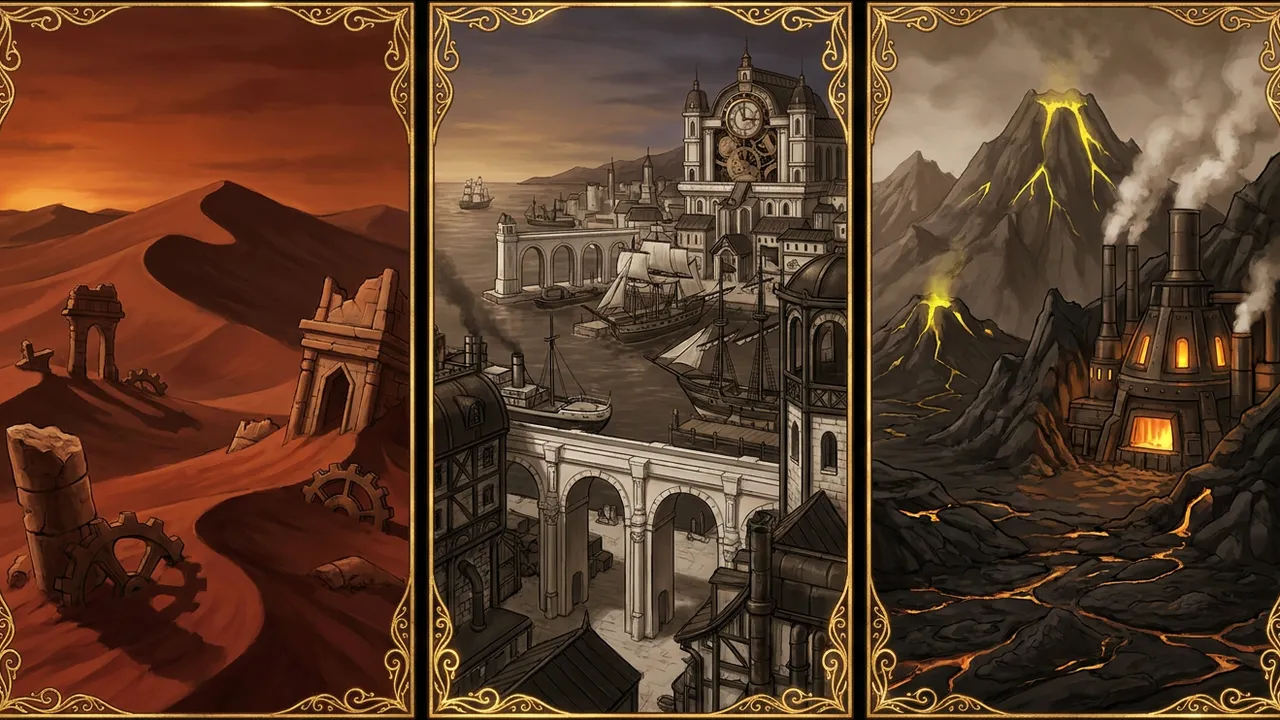
According to A History of Rislandia, the Red Desert was "a vast, arid desert stretching across the southwestern portion of the empire," situated between the Westerly Spine and the Devil's Range. Desert's Watch stood on its edge. The desert took its name from "iron-rich sand that gives it a rust-red color, especially at sunset."
The terrain consisted of sandy dunes, rocky plateaus, and scattered oases. Conditions were extreme: intensely hot during the day, cold at night, and receiving minimal rainfall. The sourcebook identifies the Wandering Dunes, the Stone Forest, oases, and ancient ruins as its principal features.
The Red Desert served the empire in several capacities. The Wyranth military used it as a training ground for soldiers, and it functioned as a natural barrier and buffer zone. Limited industries operated within it, including some mining, caravan trade, and military outposts. Desert nomads inhabited the region and traded with both Wyranth and Rislandia.
The desert was also a haven for bandits and outlaws fleeing imperial justice, and home to dangerous fauna including gagantemidae (giant snakes) and scorpions, as well as "stranger creatures." Ancient ruins dotted the landscape, described as remnants of Giant civilization or possibly older peoples; a buried city was noted among these remains. The sourcebook records that a Wyranth expedition entered the Red Desert and did not return. It also includes the adventure prompt: "Join a treasure-hunting expedition to the Red Desert."
Tyndree Region
According to A History of Rislandia, the Tyndree Region occupied the southeastern portion of the Iberanth Peninsula and was "once the independent Tyndree Kingdom, now absorbed into the Wyranth Empire." The Tyndree Kingdom was conquered by the Wyranth Empire in the 2nd Year of King Malaky XVI's Reign.
The region's terrain included coastal plains, marshlands, and rolling hills, with a temperate and humid climate marked by frequent rain — more fertile and temperate than the Wyranth heartland. Primary industries comprised agriculture, fishing, shipbuilding, and trade.
The Tyndree people were known for scholarship and artistry; many of the Wyranth Empire's finest artists, musicians, and scholars were of Tyndree descent. Some Tyndree nobles fled to Rislandia during the conquest. Despite full integration into the empire, Tyndree cultural identity persisted, and some resentment of Wyranth rule remained. The region contained High Mesa Castle and Shurrow Marsh.
Western Coast (Wyranth Side)
According to A History of Rislandia, the western coast on the Wyranth side of the Westerly Spine was "a narrow coastal strip between the mountains and the ocean, difficult to access."
Southern Coast
According to A History of Rislandia, the Southern Coast was the long coastline of the Wyranth Empire facing the Eastern Sea and was described as "the economic lifeline of the Wyranth Empire." It was characterized by rocky cliffs, natural harbors, and fishing villages, with a maritime climate of moderate temperatures and frequent storms. Primary industries included fishing, shipbuilding, naval operations, and trade, with routes connecting to Nyanzi, Zenwey, and beyond. The coast was vulnerable to naval invasion and heavily fortified. It contained Carnait Cove and the Eastern Port.
Tyndree Coast
According to A History of Rislandia, the Tyndree Coast, located within the Tyndree Region, featured natural harbors and fishing villages.
Bodies of Water
Eastern Sea
According to A History of Rislandia, the Eastern Sea formed the eastern and southern boundary of the Wyranth Empire. The Wyranth Imperial Navy conducted operations in it, and the Admiralty at the Eastern Port oversaw those operations. The sourcebook describes it as "The Eastern Sea to the east and south" and notes the Southern Coast as "facing the Eastern Sea."
Features of the Devil's Range
Several minor locations within the Devil's Range are recorded in A History of Rislandia.
Lava Fields
According to A History of Rislandia, the Lava Fields were "vast expanses of cooled lava, treacherous to cross," located within the Devil's Range.
Sulfur Mines
According to A History of Rislandia, the Sulfur Mines were located in the Devil's Range and contained "rich deposits of sulfur used in explosives and industry." Related processing operations were conducted at the Sulfur Works (see below).
Crystal Veins
According to A History of Rislandia, the Crystal Veins were scattered deposits of earth crystals and other crystal types found within the Devil's Range.
Hot Springs
According to A History of Rislandia, the Hot Springs of the Devil's Range were natural geothermal baths, described as "considered sacred by some Wyranth."
Features of the Red Desert
Wandering Dunes
According to A History of Rislandia, the Wandering Dunes were "massive sand dunes that shift with the wind, making navigation treacherous," located within the Red Desert.
Stone Forest
According to A History of Rislandia, the Stone Forest was "a region of tall rock formations carved by wind and sand," located within the Red Desert.
Features of the Tyndree Region
Shurrow Marsh
According to A History of Rislandia, Shurrow Marsh was "a vast wetland south of High Mesa Castle, difficult to traverse." It served as a natural barrier and was home to dangerous creatures. The sourcebook notes that some said it was haunted by the ghosts of Tyndree soldiers who died during the conquest.
The Eastern Port
According to A History of Rislandia, the Eastern Port was a major coastal city in the former Tyndree region, formerly the capital of the independent Tyndree Kingdom. It had a population of approximately 20,000 and was founded approximately 500 years before the sourcebook's composition by Tyndree settlers. After the Wyranth conquest, it became a major port city within the empire, retaining much of its Tyndree character and creating "a unique blend of cultures." The sourcebook states that "the city serves as a bridge between the Wyranth Empire and the wider world."
The Eastern Port was thriving economically due to international trade, dealing in goods from Nyanzi, Zenwey, Panderica, and beyond. It was also described as a center of espionage and intrigue where spies from many nations operated. The navy was noted to be on high alert due to the Nightmen threat. The sourcebook records that Duchess Liliana fled from the Eastern Port to Rislandia.
The city was divided into four principal districts: the Tyndree Quarter, the Wyranth Quarter, the Market Quarter, and the harbor district. Its subsidiary locations are detailed below.
Tyndree Quarter
Also called the Old City, the Tyndree Quarter featured original Tyndree architecture described as "white stone, arched windows, gardens," with narrow streets and hidden courtyards. Tyndree cultural traditions were preserved here. It contained the Former Royal Palace.
Former Royal Palace
According to A History of Rislandia, the Former Royal Palace was originally the Tyndree royal palace, located in the Tyndree Quarter of the Eastern Port. After the conquest it became "a Wyranth administrative building."
Wyranth Quarter
Also called the New City, the Wyranth Quarter was built after the conquest of Tyndree. It featured Wyranth-style buildings of stone and iron, contained industrial areas and military barracks, and was described as more utilitarian than the Old City.
Market Quarter
According to A History of Rislandia, the Market Quarter was one of the major districts of the Eastern Port and contained the Grand Bazaar.
Grand Bazaar
According to A History of Rislandia, the Grand Bazaar was located in the Market Quarter of the Eastern Port and was "one of the largest markets on the continent." It sold exotic spices, silks, crystals, and artifacts, and traded goods from Nyanzi, Zenwey, Panderica, and beyond. It was described as a melting pot of cultures with traders from across the world, with languages from a dozen nations spoken there, and as "a center of espionage and intrigue (spies from many nations operate here)."
Admiralty Building
According to A History of Rislandia, the Admiralty Building was the headquarters of the Wyranth Imperial Navy's eastern fleet, located in the Eastern Port. It oversaw naval operations in the Eastern Sea, protection of trade routes, anti-piracy patrols, and coordination with the Rislandian navy following the alliance between the two nations.
Shipyards of the Eastern Port
According to A History of Rislandia, the Shipyards of the Eastern Port were located in the harbor district and were "among the finest shipyards in the world." They produced warships including frigates, destroyers, and battleships; merchant vessels; experimental craft such as steam-powered submarines and armored ships; and airship components in cooperation with Isle du Mystere. They employed thousands of workers and were described as vital to the empire's naval power.
Tyndree Cultural Center
According to A History of Rislandia, the Tyndree Cultural Center was located in the Eastern Port. Despite the conquest, "Tyndree culture thrives in the Eastern Port" through this institution. It housed the Tyndree Theater and the Scholars' Guild, and Tyndree festivals were celebrated here alongside Wyranth holidays. Many Tyndree nobles served the empire while maintaining their heritage here.
Tyndree Theater
According to A History of Rislandia, the Tyndree Theater was part of the Tyndree Cultural Center in the Eastern Port and performed classical plays.
Institutions and Installations of the Wyranth Capital
Several minor locations within Wyranth Capital are recorded in A History of Rislandia.
Iron Palace
According to A History of Rislandia, the Iron Palace was the emperor's residence in Capital City, described as "a fortress of dark stone and iron" — built of dark volcanic stone and reinforced with iron, and designed to withstand siege. It contained a throne room with a ceiling painted to depict the Wyranth creation myth, private chambers for the emperor and his family, a war room where military strategy was planned, laboratories where scientists conducted research including experiments with giant's blood, and an underground prison holding some of the Wyranth's worst enemies. The sourcebook describes it as "both beautiful and intimidating."
Grand Opera House
According to A History of Rislandia, the Grand Opera House was located in the Imperial District of Capital City and was "a magnificent structure rivaling any in the world." It seated 2,000 people, with acoustics designed by the empire's finest engineers. Performances included operas, plays, symphonies, and ballets, and the state sponsored productions making them free to the public. Attending was described as a mark of culture and status. The sourcebook records that it was built by Emperor Eisenherz, who believed "a strong empire must also be cultured." Ivan, the Iron Emperor attended it. The sourcebook also notes as an adventure hook "a Resistance plot to bomb the Grand Opera House during the emperor's attendance."
Imperial Museum
According to A History of Rislandia, the Imperial Museum was located in Capital City and was open to the public free of charge. It housed artifacts from the Age of Giants, art from across the known world, historical exhibits on Wyranth history, and trophies from military victories. It was described as "housing art, artifacts, and historical treasures" and was noted as having been influenced by Tyndree culture.
Hall of Emperors
According to A History of Rislandia, the Hall of Emperors was located within the Imperial Museum and contained "statues and portraits of past rulers."
The Great Library
According to A History of Rislandia, the Great Library of the Wyranth capital was "one of the largest libraries on the continent," open to scholars and students. It contained scientific treatises, historical records, and literature, and included a restricted section known as the Forbidden Section.
Forbidden Section
According to A History of Rislandia, the Forbidden Section was a part of the Great Library containing "books on dangerous topics, accessible only to scholars with imperial permission," also described as holding "dangerous or subversive texts."
Geothermal Baths
According to A History of Rislandia, the Geothermal Baths were public baths in Capital City fed by hot springs from Devil's Mountain. They were free to all citizens and served as social gathering places. The sourcebook notes they were considered sacred by some and believed to have healing properties. They reflected the Wyranth value of communal strength — all citizens regardless of rank bathed together — and were provided as part of the state's healthcare.
Foundries of Capital City
According to A History of Rislandia, the Foundries were located in the Industrial Quarter of Capital City and were described as "the heart of the Wyranth war machine." Massive furnaces powered by geothermal energy from Devil's Mountain operated day and night. Production included swords, spears, and other melee weapons; rifles, pistols, and ammunition; cannons and artillery pieces; steam engines for ships and machinery; and armor for soldiers and automatons. Workers were described as well-paid but facing dangerous conditions.
Industrial Installations
Sulfur Works
According to A History of Rislandia, the Sulfur Works were scattered throughout the Devil's Range. The sourcebook states that "the Wyranth have established sulfur mining and processing facilities throughout the volcanic mountains." Production included gunpowder and other propellants, industrial chemicals, and alchemical compounds for research and medicine. The facilities were dangerous due to explosions and toxic fumes, and workers were rotated frequently to limit exposure.
The Strait
According to A History of Rislandia, the Strait was the narrow body of water between Isle du Mystere and the mainland, described as "treacherous but vital." Wyranth ships transported automatons and airships across it, and it was noted as a strategic target for enemies.
Social Institutions
Workers' Clubs
According to A History of Rislandia, Workers' Clubs were state-run social clubs operating within Wyranth, offering "games, music, and lectures" to working-class citizens.